
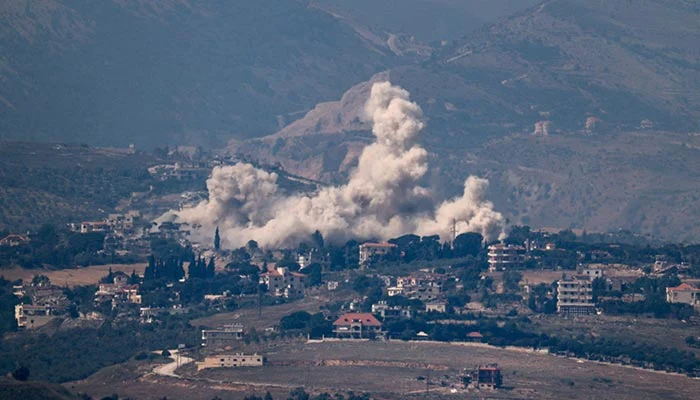
Iran Launches Fresh Strikes After Latest US Military Attacks
Iran Targets US Bases Following New American Military Strikes Across Region

TEHRAN: (Special Reporter) – Tensions between Iran and the United States intensified after Iran claimed it launched missile and drone attacks on American military facilities in Kuwait and Jordan following a fresh round of US airstrikes.
According to Iranian state television IRIB, the Iranian Army said it targeted US communication systems and fuel storage facilities in Jordan using kamikaze drones. The Islamic Revolutionary Guard Corps (IRGC) also announced that it carried out a combined missile and drone strike on Ali Al Salem Air Base in Kuwait as part of the eighth phase of its “Nasr 2” military operation.
The IRGC stated that the attack focused on a C-RAM early-warning radar system and an area where US troops were stationed. It also accused Washington of using Kuwaiti territory to conduct attacks against Iran and urged Kuwaitis to demand the withdrawal of American forces from their country.
Meanwhile, US Central Command confirmed it completed another series of military strikes ordered by President Donald Trump. The operation targeted Iranian command centers, air defense systems, missile and drone infrastructure, and coastal surveillance facilities, including military sites in Bandar Abbas, home to Iran’s largest port and key naval bases near the Strait of Hormuz.
Iranian media reported explosions and active air defenses in Tehran, as well as blasts in Lorestan, Semnan, Bandar Abbas, Rask, Chabahar, Bushehr, Qeshm and Bandar Imam Khomeini. Officials said no casualties had been reported in Tehran following the attacks.
The US military said the latest operation was designed to reduce Iran’s ability to threaten commercial shipping through the Strait of Hormuz. It also announced that an American aircraft disabled the Curacao-flagged oil tanker M/T Belma after it allegedly attempted to violate the naval blockade imposed on Iranian ports. According to US Central Command, Hellfire missiles were fired into the vessel’s smokestack, preventing it from reaching Iran.
Regional tensions continued to spread as Iran’s Revolutionary Guards claimed responsibility for targeting the US Fifth Fleet in Bahrain. Air defense systems intercepted attacks over Bahrain, while Jordan’s military said it destroyed three incoming Iranian missiles. In Iraq, Kurdish security forces reported that the US-led coalition intercepted eight explosive drones near Erbil, where explosions were heard close to the US consulate, although no casualties were reported.
President Donald Trump warned that the US could significantly expand its military campaign if Iran refuses to return to negotiations, saying additional infrastructure could be targeted in the coming days. Despite the renewed fighting, diplomatic talks between Washington and Tehran have not officially collapsed.
However, Iran’s senior negotiator Mohammad Bagher Ghalibaf questioned the future of the recently signed memorandum of understanding, saying it holds no value if its terms are not respected. Iranian officials argued that renewed US military actions have effectively undermined the agreement.
The Strait of Hormuz remains at the center of the crisis. Iran has repeatedly threatened to close the vital shipping lane, a move that has sharply reduced maritime traffic and pushed global oil prices higher. Shipping tracker Kpler reported only limited vessel movements through the strategic waterway following the latest escalation.
Iranian Deputy Foreign Minister Kazem Gharibabadi said the renewed US naval blockade had effectively dismantled the previous understanding reached between the two countries. Residents across Iran and neighboring Gulf states described growing fear as explosions and missile alerts became increasingly common.
Iranian authorities said at least 30 people have been killed since the latest wave of US strikes began, while seven Iranian military personnel reportedly died in attacks on southeastern Iran. A hospital in Ahvaz was also evacuated after nearby airstrikes, with patients transferred to other medical facilities.
Israeli Prime Minister Benjamin Netanyahu warned that Israel would respond with force if Iran launched attacks against Israeli territory, adding another layer of uncertainty to the rapidly escalating regional conflict.
Comments are closed, but trackbacks and pingbacks are open.