

Iran Hits Gulf Shipping Route as G7 Taps Oil Reserves
Iran attacks ships near the Strait of Hormuz as war fears rise and global powers move to release emergency oil reserves.

Strait of Hormuz – (Web Desk) – Iran fired at two commercial ships in the Gulf on Wednesday. One of the vessels caught fire after the attack. The move is part of Iran’s growing pressure on nearby oil-exporting countries. The situation also pushed several governments to use their emergency oil reserves.
Oil prices quickly jumped more than five percent in early trading. Markets have been unstable since the end of last month. That was when the United States and Israel carried out attacks inside Iran. The strikes killed Iran’s supreme leader and started a wider war in the Middle East.
The conflict has now reached its twelfth day. Iran warned that it may target banks and economic centres it believes are linked to US and Israeli interests. Many countries are closely watching the Strait of Hormuz. This narrow water route connects Gulf oil and gas exports to the rest of the world.
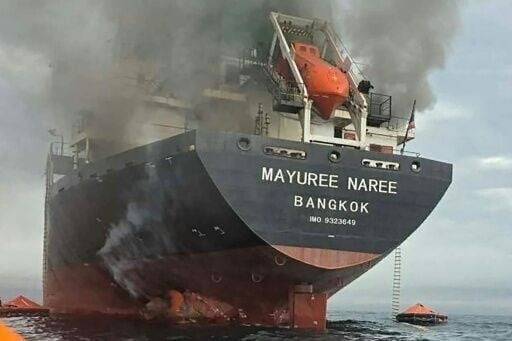
Iran’s Revolutionary Guard said it attacked two ships. One was the Liberian-flagged container ship Express Rome. The other was the Thai bulk carrier Mayuree Naree. Iran claimed the vessels entered the Strait of Hormuz without following warnings from its naval forces.
Thailand’s navy confirmed that the Mayuree Naree was hit while passing through the strait. Oman’s navy later rescued 20 crew members from the ship. Search teams are still looking for three missing sailors. Photos shared by the Thai navy showed thick black smoke rising from the damaged vessel.
A senior Iranian naval commander, Alireza Tangsiri, said online that ships must get permission from Iran before passing through the area. At the same time, Iran’s military command warned on state television that ships linked to the United States, Israel, or their allies could be treated as targets. It also said it would try to stop oil shipments through the strait.
Because of rising oil prices, leaders of the G7 countries held an emergency video meeting. They discussed releasing oil from their strategic reserves. The move would be done with help from the International Energy Agency.
Germany’s energy minister Katherina Reiche said the agency asked member countries to release 400 million barrels of oil. Germany said it would support the plan. Japan also said it is ready to release oil from its reserves by Monday, even if the agency has not yet made a final decision.
The Strait of Hormuz is one of the world’s most important energy routes. About 20 percent of global oil and liquefied natural gas passes through this narrow waterway. Experts say a long closure of the strait could badly hurt the global economy, especially in Asia and Europe. The route also carries a large share of fertiliser used in world food production.
The United States military said it recently destroyed 16 Iranian vessels that could have been used to place sea mines in the strait. Still, attacks using drones and missiles continued on Wednesday. At least three ships were reported to be hit.
US President Donald Trump warned Iran on social media that placing mines in the strait would bring serious military consequences.
Israel also said it launched a new wave of strikes across Iran and against Hezbollah positions in Beirut, Lebanon. Israeli Defence Minister Israel Katz said the operation would continue as long as needed.
The conflict is also affecting nearby areas. Drones fell near Dubai airport and injured four people, according to local officials.

President Trump suggested that the US Navy might escort oil tankers through the Strait of Hormuz. However, some experts doubt that naval escorts alone will be enough to make the route safe again for global shipping.
“The security risks alone could make a single transit through the strait more costly than the profit margin on the oil shipment itself,” the Soufan Center think tank said in a briefing note.
“Experts estimate that Iran’s naval mine stockpile sits anywhere from 2,000 to 6,000 mines, which would further complicate any naval plan to escort commercial tankers,” it said.
The Israeli-US attacks came weeks after Iranian authorities ruthlessly crushed mass protests, although the United States and Israel say they are not necessarily seeking to topple the Islamic republic.
Iranian authorities warned against dissent at home, with the country’s police chief saying protesters would be viewed and dealt with as “enemies”.
“All our forces are also ready, with their hands on the trigger, prepared to defend their revolution,” national police chief Ahmad-Reza Radan said, in comments aired by IRIB.
In Iran, ordinary people were doing the best they could to adapt to living under frequent US-Israeli strikes.
“We’ve put our faith in God. For now, there’s food in the shops. Every day I go to buy greens and bread, that’s all,” Tehran resident Mahvash, 70, told AFP journalists in Paris.
“People are calm,” said another resident. “They are getting used to living despite everything and adapting — as best they can — to this situation.”
The United States and Israel launched the war on February 28 with an attack that killed Iran’s veteran leader, Ayatollah Ali Khamenei.
His son Mojtaba Khamenei has been named his successor, though he has yet to appear in public, amid reports that he has been wounded.
“I heard news that Mr Mojtaba Khamenei had been injured. I have asked some friends who had connections. They told me that, thank God, he is safe and sound,” said Yousef Pezeshkian, son of Iran’s president, in a post.
Iran’s health ministry said on March 8 that more than 1,200 people had been killed in US and Israeli strikes, and more than 10,000 civilians injured. AFP was not in a position to independently verify the figures.

Comments are closed, but trackbacks and pingbacks are open.