

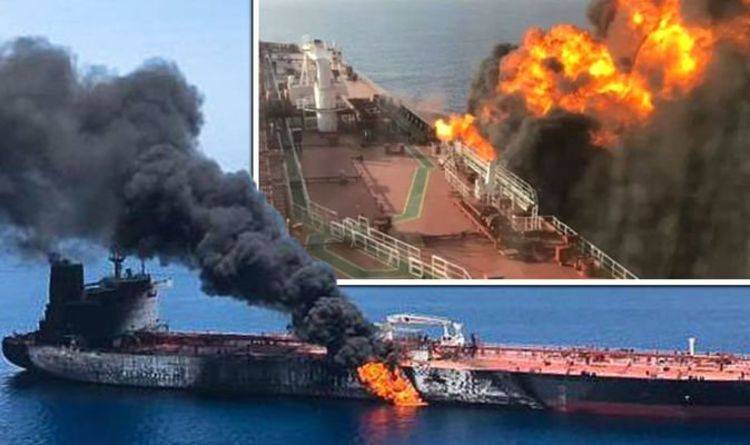
Iran Attacks Tankers As Oil Prices Surge Globally
Iran Strikes Tankers Oil Prices Jump Amid Widening Middle East War

TEHRAN: (Web Desk) Global oil prices surged sharply on Thursday while stock markets fell after Iran targeted three oil tankers near Iraqi waters and warned that the conflict could destabilize the global economy. The development overshadowed a historic move by the International Energy Agency to release strategic crude reserves in an attempt to calm energy markets.
As military tensions between United States, Israel and Iran entered their third week, the conflict intensified with Tehran launching retaliatory strikes across the Gulf region. The IEA announced that member countries had agreed to release about 400 million barrels of oil from emergency reserves, including 172 million barrels from the United States.
Despite the large release of oil supplies, fears of disruptions in the Middle East continued to dominate markets. The strategic Strait of Hormuz — a vital route through which nearly one-fifth of the world’s crude oil flows — has effectively been closed amid rising security threats.
Shipping in the region also came under direct threat. Two oil tankers in Iraqi waters were struck, leaving one crew member dead and dozens rescued. Iraqi port official Farhan Al‑Fartousi confirmed that 38 crew members were saved while rescue teams continued searching for those still missing. Iraqi authorities described the incident as sabotage but did not identify who carried out the attack.
Another container vessel was reportedly hit by a projectile near the United Arab Emirates, causing a small onboard fire though the crew remained safe. Meanwhile, Iran signaled readiness for a prolonged conflict that could severely impact global trade and financial systems.
Senior Iranian military adviser Ali Fadavi warned that the United States and Israel should prepare for a long war of attrition that could damage both the American and global economies. Iran’s Islamic Revolutionary Guard Corps also threatened to target economic centers and financial institutions linked to US and Israeli interests.
Energy analysts say a prolonged disruption in the Strait of Hormuz could trigger a major economic shock worldwide, particularly in Asia and Europe. Airlines have already begun adjusting routes and reducing flights due to rising fuel costs and safety concerns. For example, Air New Zealand announced plans to cancel more than 1,100 flights in the coming weeks.
Oil prices spiked dramatically, with both major crude benchmarks jumping more than seven percent and approaching $100 per barrel again. Earlier in the week prices surged as high as nearly $120, marking one of the largest spikes in recent years.

Market analysts warn that continued instability in the Middle East could keep oil prices elevated in the $90 to $100 range for an extended period.
Israel Strikes Lebanon After Hezbollah Iran Rocket Attack
Meanwhile, Donald Trump claimed that US strikes had already significantly weakened Iran, telling reporters in Washington that Tehran was “pretty much at the end of the line.”
The conflict also expanded across the region. Bahrain reported Iranian strikes on fuel storage facilities in the Muharraq Governorate and urged residents to remain indoors due to heavy smoke from fires.
Saudi Arabia announced that its air defenses had intercepted a drone approaching the diplomatic district in Riyadh, while Kuwait said several drones targeting its territory were also shot down.
Israel’s military said Iran launched multiple waves of missiles toward Israeli territory, prompting widespread air-raid sirens across cities including Jerusalem. In response, Israel conducted large-scale strikes on targets in Tehran and Hezbollah positions in Beirut.
Lebanese authorities reported that an Israeli strike along Beirut’s seafront killed seven people and injured more than twenty others. The ongoing clashes have pushed the death toll in Lebanon to more than 630 people and displaced hundreds of thousands.
At the diplomatic level, the United Nations Security Council adopted a resolution calling on Iran to halt attacks on Gulf states. The vote passed 13-0, with China and Russia abstaining.

Comments are closed, but trackbacks and pingbacks are open.