
Iran allows increased passage of Pakistani ships through Strait of Hormuz in positive gesture
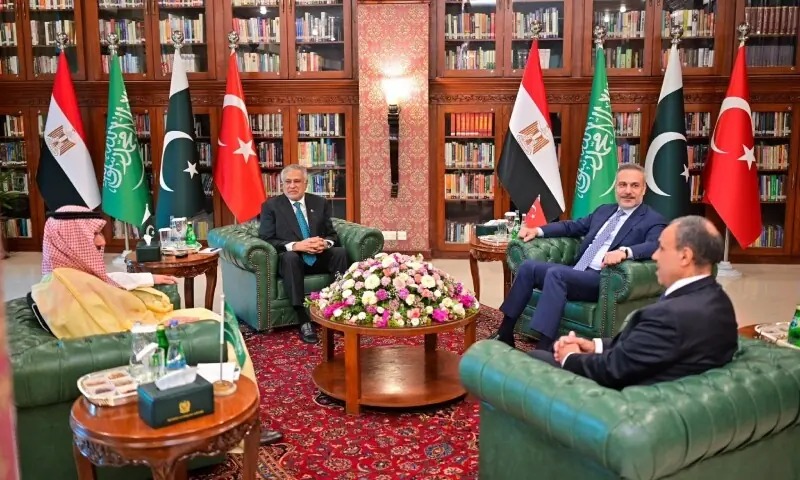
High-level diplomacy in Islamabad as foreign ministers of Saudi Arabia, Turkey, and Egypt meet Prime Minister

Islamabad-(Asghar Ali Mubarak/News Desk)- The meetings of the Foreign Ministers of Pakistan, Saudi Arabia, Turkey, and Egypt with the Prime Minister of Pakistan in the context of promoting peace and cooperation in the region highlight Pakistan’s growing diplomatic importance and strengthen Pakistan’s active role in international relations.
In view of the ongoing tense situation in the Middle East, the Foreign Ministers of Saudi Arabia, Turkey, and Egypt, who came to Pakistan to make efforts for peace, met Prime Minister Shehbaz Sharif.
Prime Minister Shehbaz Sharif assured Saudi Foreign Minister Faisal bin Farhan during the meeting that Pakistan will always stand by his country.
Saudi Foreign Minister Faisal bin Farhan met Prime Minister Shehbaz Sharif. Deputy Prime Minister Ishaq Dar, National Security Advisor Lt. Gen. Muhammad Asim Malik, and Special Assistant were present on the occasion. According to the statement issued on the meeting, the meeting between the Prime Minister and the Saudi Foreign Minister took place in a pleasant and friendly atmosphere.
Shahbaz Sharif warmly welcomed Faisal bin Farhan and expressed his best wishes for King Salman, while also sending a message of goodwill to Crown Prince Muhammad bin Salman. According to the statement, Pakistan’s unwavering solidarity with Saudi Arabia was reiterated. The Prime Minister appreciated Saudi Arabia’s extraordinary restraint in the current crisis and assured that Pakistan will always stand by Saudi Arabia.
The Prime Minister referred to his discussions with Crown Prince Muhammad bin Salman in recent days. The meeting held in Jeddah on March 12 was also referred to. Shahbaz Sharif informed about Pakistan’s extensive diplomatic efforts during the current crisis and efforts to bring the US and Iran to the negotiating table. The statement further said that the Prime Minister had expressed his support for the Islamic countries at a critical time. Highlighting the need for unity among the countries, Saudi Foreign Minister Faisal bin Farhan thanked him and informed him of Saudi Arabia’s position on the situation in the region.
Deputy Prime Minister Ishaq Dar and National Security Advisor were also present at the meeting of the Foreign Ministers of Turkey and Egypt with Prime Minister Shehbaz Sharif. Turkish Foreign Minister Hakan Fidan and Egyptian Foreign Minister Dr. Badr bin Abdul Ati were warmly welcomed by Special Assistant Tariq Fatemi upon their arrival at the Prime Minister’s House. Meanwhile, a consultative meeting of the Foreign Ministers of Pakistan, Saudi Arabia, Turkey, and Egypt has begun in Islamabad to reduce the ongoing tension in the Middle East. Deputy Prime Minister and Foreign Minister Ishaq Dar of Pakistan, Saudi Foreign Minister Faisal bin Farhan, Turkish Foreign Minister Hakan Fidan, and Egyptian Foreign Minister Dr. Badr Abdul Ati are participating in the meeting.
The foreign ministers of the four countries are discussing the current situation in the region, especially the ongoing tensions in the Middle East and the possibilities of a ceasefire. The meeting is being held at the invitation of the Deputy Prime Minister of Pakistan and Foreign Minister Senator Muhammad Ishaq Dar. During the consultative meeting, the changing situation in the region, including the tension between the United States, Israel, and Iran, will be reviewed in detail. In addition, the participants will discuss various issues of mutual interest so that cooperation can be further strengthened for peace and stability in the region. This meeting is taking place at a time when the tension between Iran, the United States, and Israel has affected the entire region, and its effects are being felt at the global level.
On the other hand, Pakistan’s Deputy Prime Minister and Foreign Minister Ishaq Dar has said that Pakistan is continuing its efforts to establish peace in the region with good intentions. He said that he is in touch with all parties, including Iran, and believes in resolving issues through dialogue. He added that Pakistan attaches great importance to its relations with its brotherly countries, Saudi Arabia, Turkey, and Egypt, and this visit will provide an opportunity to further strengthen cooperation in various fields. Foreign Minister Ishaq Dar has contacted his Qatari and Iranian counterparts, in which the situation and progress in the region were discussed. Ishaq Dar stressed the need to reduce tensions in his conversation with Abbas Araqchi.
Talks were also held with the Prime Minister and Foreign Minister of Qatar, and the diplomatic efforts of Pakistan for peace and stability were appreciated by the Qatari leadership. Earlier, Iran had allowed more Pakistani-flagged ships to pass through the Strait of Hormuz. Ishaq Dar wrote in X-Post that two Pakistani ships will be allowed to pass through the Strait of Hormuz daily. This move by Iran is welcome, constructive, and a harbinger of peace in the region. Ishaq Dar also tagged US Vice President JD Vance, Secretary of State Marco Rubio, Steve Witkoff, and Iranian Foreign Minister Abbas Araqchi in the tweet. Iranian President Dr. Masoud Peshkian on Saturday appreciated Prime Minister Shehbaz Sharif’s sincere diplomatic efforts and stressed that there is an urgent need for mutual trust-building for dialogue and mediation to reduce tensions in the Middle East. According to a statement issued by the Media Wing of the Prime Minister’s Office, during the telephonic conversation, President Peshkian praised Prime Minister Shehbaz Sharif for Pakistan’s supportive role for peace in the region. The President also expressed his position regarding the recent aggressive intentions and attacks launched by Israel against Iran. The leaders had a detailed discussion regarding the ongoing aggression and peace efforts in the region. During the detailed discussion that lasted for over an hour, Prime Minister Shehbaz Sharif reiterated Pakistan’s condemnation of Israel’s continued attacks on Iran, including the recent attacks on civilian infrastructure on Friday.
He reiterated Pakistan’s solidarity and support for the brave people of Iran in these difficult times. The Prime Minister expressed his condolences for the loss of over 1900 precious lives and prayed for the speedy recovery of the injured and the displaced. The Prime Minister briefed the Iranian President on the ongoing diplomatic engagements of himself, Deputy Prime Minister Ishaq Dar, and Field Marshal Syed Asim Munir with the United States, brotherly Gulf, and Islamic countries aimed at creating a conducive environment for peace talks. He expressed his strong support for Pakistan’s peace initiative and expressed hope that joint efforts would lead to an effective way out of the tension. Prime Minister Shehbaz Sharif thanked the Iranian President and assured him that Pakistan would continue its constructive role in bringing peace and stability to the region.
In a social media post, Prime Minister Shehbaz Sharif also said that he thanked the Iranian President for appreciating Pakistan’s sincere efforts to advance peace in the region and facilitate negotiations. He added that I informed him of Pakistan’s ongoing diplomatic outreach with the United States, brotherly Gulf and Islamic countries, remembering that the process of negotiations and de-escalation can be facilitated.
Pakistan hosts key talks to ease Iran tensions
Or, the risk of regional war has increased after the continuous attacks of the United States and Israel on Iran. Meanwhile, Pakistan has emerged as an unexpected mediator, offering its services to bring Washington and Tehran to the negotiating table. The American news agency has claimed that Pakistan has agreed to play this role of mediator for several reasons, one of which is that Pakistan has relatively good relations with both Washington and Tehran, and the other is that Pakistan has a huge interest in ending this war. Pakistani officials say that these peace efforts are the result of weeks of quiet diplomacy. Pakistan’s role in the Iran-US talks was revealed a few days ago.
Officials in Islamabad later admitted that a 15-point US proposal had been conveyed to Iran. It is not yet clear who the Iranian liaison is in these indirect talks. Iran has officially denied any such talks and has rejected the US proposal, but Tehran has admitted that it has responded to the US proposals with its own proposals. The report quotes Pakistani officials as claiming that US messages are being conveyed to Iran and Iranian responses to Washington. Pakistan’s Foreign Minister Ishaq Dar said this week that Turkey and Egypt are also working behind the scenes to bring the parties to the negotiating table. Countries such as Oman and Qatar have mediated in past US-Iranian talks, but Pakistan has taken on this role after these countries themselves came under Iranian attack in the current war. Experts say Pakistan is in a unique position because of its proximity to Iran and its long-standing ties with the US. Islamabad has working relations with key parties involved in the war.
It has close strategic ties with Gulf countries, including Saudi Arabia, with which it signed a defense cooperation agreement last year. However, Pakistan has no diplomatic relations with Israel due to the Palestinian issue. US-Pakistan relations have improved over the past year. Pakistan has also joined Trump’s “Board of Peace” aimed at ensuring peace in Gaza.
President Trump recently spoke to Pakistani Army Chief Field Marshal Asim Munir, whom the US president has publicly described as his “favorite field marshal.” The dispute is one of the “biggest economic and energy challenges” in Pakistan’s history. Pakistan gets most of its oil and gas from the Middle East, and the five million Pakistanis working in Arab countries send back as much foreign exchange as Pakistan’s total export earnings. The rising tensions have pushed up global oil prices, forcing the government to increase fuel prices in the country by up to 20 percent. The war is also having an impact on Pakistan’s internal affairs.

Trump’s Negative Comments on MBS Draw International Reaction
Protests erupted across the country after the US attacks on Iran. At least 22 people were killed, and more than 120 were injured in clashes in Karachi and northern areas following the assassination of Supreme Leader Ayatollah Ali Khamenei. Twelve people were killed when an angry mob attacked the US consulate in Karachi. Although Pakistan rarely acts as a mediator, its record includes important negotiations. In 1972, President Yahya Khan facilitated behind-the-scenes contacts for US President Richard Nixon’s historic visit to China.
Pakistan’s greatest diplomatic achievement came in 1971 when it helped bring the world’s two greatest rivals, the US and China, closer together. In July 1971, Pakistan carried out a secret and sensational mission that was nothing short of a movie plot to restore diplomatic relations between the US and China, which had been severed for decades. The central character in the mission was US President Richard Nixon’s national security adviser, Henry Kissinger.President Yahya Khan devised a very careful plan to keep his trip to Beijing hidden from the world.
At that time, both China and the United States wanted to get closer to each other due to their political and strategic constraints (such as tensions with the Soviet Union and the Vietnam War), but direct contact was difficult due to twenty years of hostility. According to the plan, Henry Kissinger paid an official visit to Islamabad in July 1971, from where he was to secretly leave for Beijing. To hide his absence in Islamabad, the news was spread that he was resting at a rest house in Nathia Gali due to severe fatigue and poor health due to eating “mango”.
However, in reality, he was accommodated in Nathia Gali with a look-alike assistant protocol and was even examined by a doctor who did not recognize Kissinger. Meanwhile, Kissinger flew over the Karakoram Highway to Beijing in a special PIA plane, the crew of which was largely unaware of the mission, and had a historic meeting with Chinese Premier Chou En-lai.
Pakistan, China Reaffirm Support for Diplomacy and Regional Stability
After this successful secret visit, President Nixon informed the world about the mission on July 15, 1971, and visited China himself the following year, paving the way for the “Shanghai Declaration” and finally formal diplomatic relations in 1979. This important development changed the global context of the Cold War and also reduced tensions between the United States and the Soviet Union. Although Pakistan changed the course of world history through this great diplomatic service, according to former Foreign Secretary Sultan Muhammad Khan, Pakistan could not meet the expectations it had from the two major powers in its difficult circumstances at that time (the 1971 war). Similarly, during the Arab-Israeli wars of 1967 and 1974, Pakistan’s role was not limited to mere rhetoric. Pakistan not only provided strong diplomatic support to the Arab countries, but its expert pilots also shot down Israeli planes while defending the airspace of Jordan and Syria.
The story is very interesting. Pakistani pilot Sattar Alvi, who participated in this operation, said in various interviews that he shot down an Israeli ‘Mirage’ plane on April 26, 1974, using a ‘MiG-21’ aircraft of the Syrian Air Force. This incident was unique in that Pakistan does not recognize Israel, but Pakistani pilots voluntarily participated in this war on behalf of another country (Syria).
According to Sattar Alvi, during the Arab-Israeli War of October 1973, he offered his services along with his colleagues, upon which the then Prime Minister Zulfikar Ali Bhutto and the Air Chief decided to send 16 pilots to the Middle East with the consent of Syrian President Hafez al-Assad. Sattar Alvi said that before departure, these pilots were asked to sign a legal document according to which the Pakistani government would not be responsible for any unexpected situation they faced.
According to him, the eight pilots who arrived in Syria were named ‘67A Unit’ and were assigned defensive duties near Damascus. Despite the Russian-made aircraft and the Arabic language, the Pakistani pilots quickly adapted to the situation. On April 26, while returning from a defensive mission, Sattar Alvi encountered Israeli aircraft. Despite running out of fuel and losing radar contact, he used an aerial technique called ‘scissors’ to target an Israeli Mirage. Sattar Alvi says that the second he fired the missile was the longest moment of his life, after which the missile hit the Israeli aircraft and destroyed it.
After this battle, Sattar Alvi landed his plane safely with very little fuel. The Syrian army captured the wounded Israeli pilot, Captain Lutz, from there, who later succumbed to his injuries. The Syrian government awarded Sattar Alvi with the country’s highest honor and gave him the Israeli pilot’s flying suit as a trophy. The Pakistani government kept the incident a secret for a long time, but later Sattar Alvi was awarded the ‘Star of Courage’ for his bravery.
Apart from this incident, during the Arab-Israeli War, Pakistan also raised an effective voice for a ceasefire on the United Nations platform in these critical circumstances and submitted several resolutions to resolve the conflict. The Korean Peninsula War, which lasted from 1950 to 1953, was actually a major proxy war of the Cold War that divided Korea into two parts. In this war, North Korea was supported by the Soviet Union and China, while South Korea was supported by the United States and the United Nations. Pakistan’s role in the liberation of South Korea from North Korea, the deployment of peacekeeping forces, and the safe return of prisoners of war is still viewed with respect in Korean history.
Although an armistice was signed in 1953, the war never officially ended, and tensions remain. Founded in 1947, Pakistan was aligned with the Western bloc from the outset and supported the United Nations’ efforts in Korea despite the pressures of the Cold War. In 1950, then Prime Minister Liaquat Ali Khan supported the US position against communist expansion by supporting UN action in favor of South Korea.
The Korean War further increased Pakistan’s defense cooperation with the United States, which resulted in Pakistan becoming a party to agreements such as SEATO in 1954 and CENTO in 1955. However, a paradox also emerged: from the 1970s, Pakistan established a separate security partnership with North Korea.The relationship began with Zulfikar Ali Bhutto’s visit to North Korea in 1976, which later came under fire in the 1990s over allegations of missile technology transfers. In addition to these complex defense ties, Pakistan also maintains strong trade and diplomatic ties with South Korea. The importance of these ties can be gauged from high-level visits, such as General Pervez Musharraf’s visit to Seoul in 2003, which was a step towards strengthening the economic and diplomatic partnership between the two countries.
In recent years, Pakistan has facilitated contacts between the Afghan Taliban and Washington, which resulted in the 2020 Doha Agreement and the withdrawal of NATO forces from Afghanistan. Thus, Pakistan’s foreign policy has been a constant effort to maintain a balance between strategic interests, defense needs, and trade relations with regard to the Korean conflict. In recent years, Pakistan has also established itself as a responsible state.


Comments are closed, but trackbacks and pingbacks are open.