

Institutionalized Repression and the Crisis of Rights in IIOJK
Human Rights in Kashmir: A Region Under Siege

By Kainat Shahzad
The human rights situation in Indian Illegally Occupied Jammu and Kashmir (IIOJK) has reached a critical juncture where repression appears institutionalized rather than incidental. The scale, consistency, and normalization of restrictive measures suggest a deliberate restructuring of civic and political space, in which fundamental freedoms are increasingly subordinated to control. This evolving reality not only undermines the rule of law but also raises profound concerns about the erosion of basic rights in a region already marked by prolonged conflict.
A central concern is the growing intolerance toward dissent. Individuals who express political opinions, advocate for dialogue, or support the right to self-determination often face serious repercussions. These may include surveillance, intimidation, and legal action under broad and stringent security laws. Such measures have created a climate in which even peaceful expression is discouraged, effectively limiting freedom of speech and narrowing the scope for political engagement. As a result, public discourse has become constrained, with many choosing silence over the risk of punitive consequences.
The extensive use of arbitrary detention remains one of the most troubling features of the current situation. A significant number of individuals—including youth, civil society actors, and political figures—are reportedly detained without due process. In many cases, prolonged incarceration occurs without formal charges or fair trial, raising serious concerns under international human rights law. Detention conditions are frequently described as inadequate, contributing to deteriorating physical and mental health among detainees. Families are often left without information, further compounding the psychological toll and deepening societal distress.
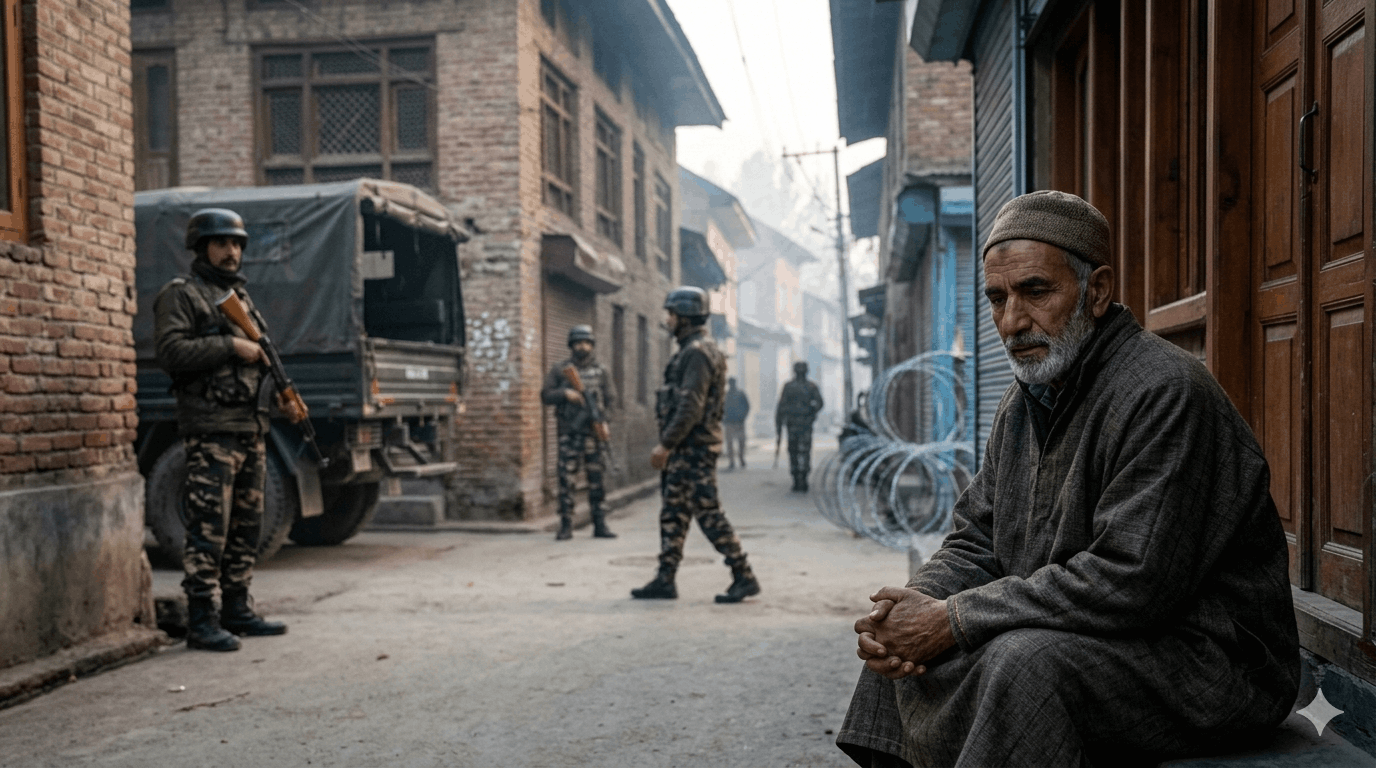
Daily life is also shaped by an enduring security presence. Frequent cordon-and-search operations, raids, and movement restrictions have become normalized, particularly in densely populated areas. These operations, often involving large numbers of security personnel, disrupt routine activities and generate an atmosphere of uncertainty. Civilians, including women and children, are regularly exposed to intrusive searches and questioning, reinforcing a sense of vulnerability. The normalization of such measures has blurred the boundary between security enforcement and civilian life.
Concerns regarding excessive use of force and extrajudicial actions have further intensified the demand for accountability. Incidents described locally as “fake encounters” continue to surface, contributing to a perception that legal safeguards are insufficiently enforced. The absence of transparent investigations and limited avenues for redress have fostered a broader sense of impunity. This, in turn, erodes trust in institutions and weakens the rule of law, making it increasingly difficult for affected communities to seek justice.

Another critical dimension of the situation relates to concerns over demographic changes. Policies that facilitate the settlement of non-local populations are widely viewed with apprehension. Such measures are perceived as having the potential to alter the region’s social fabric and political character. For many, this raises questions about the preservation of cultural identity and the future trajectory of the region’s political status. These anxieties are closely tied to longstanding aspirations for self-determination and meaningful participation in decisions affecting the region.
The portrayal of the Kashmiri political struggle in dominant narratives has also been a source of contention. Efforts to frame local demands primarily through a security lens are seen as reductive, overlooking the historical and political context of the dispute. This framing not only delegitimizes local grievances but also complicates prospects for dialogue by reinforcing adversarial positions. A more nuanced understanding, grounded in political realities and human rights considerations, is widely regarded as essential for any sustainable resolution.
International attention to the situation has remained uneven, despite recurring concerns raised in various global forums. Reports by human rights organizations and independent observers have documented patterns of excessive force, arbitrary detention, and restrictions on civil liberties. However, the absence of sustained and coordinated international engagement has limited the impact of these findings. There is a growing perception that stronger mechanisms of accountability, including independent fact-finding initiatives, are necessary to ensure transparency and adherence to international norms.
Three Cheers for Pakistan – When Islamabad Interrupted History
Despite these challenges, the resilience of the people remains a defining feature of the region. Communities continue to navigate complex and often adverse conditions while maintaining a commitment to dignity and justice. The persistence of these aspirations underscores the importance of addressing the situation through inclusive dialogue and lawful means. Without such efforts, there is a risk that the current trajectory may further entrench instability, with broader implications for peace and security in South Asia.
The writer is a student of Political science at the University of Punjab. Currently she is serving as an intern at the Kashmir Institute of International Relations, Islamabad.

Comments are closed, but trackbacks and pingbacks are open.