

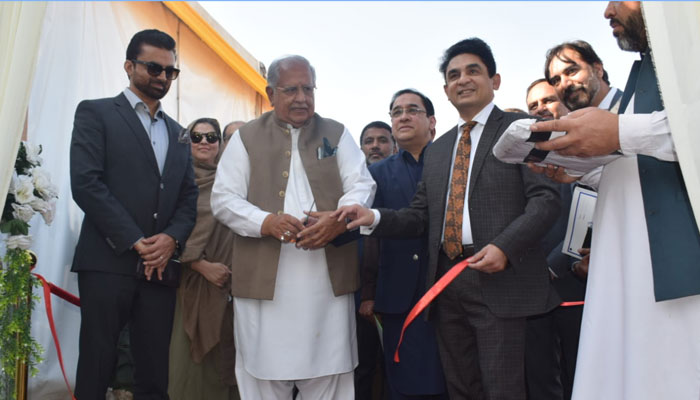

In the context of Islamabad’s urban expansion and the growing need for quality housing for federal employees, the groundbreaking ceremony for infrastructure development in Sectors F-14 and F-15 by the Federal Government Employees Housing Authority (FGEHA) has emerged as a highly significant development. The ceremony held on February 16 is not merely a formal activity but marks the beginning of a new phase in residential planning in the federal capital, one that carries the hopes of thousands of allottees. Given Islamabad’s organized urban structure and the mounting pressure of population growth, such projects have become not just necessary but strategically indispensable. This is why the government is moving forward with this project on a priority basis to ensure timely and quality housing facilities for federal employees.
The FGEHA was originally established to provide dignified housing to federal government employees, and over the years the authority has worked on several residential projects. However, the importance of Sectors F-14 and F-15 is heightened by the fact that they are located in areas of Islamabad where there is substantial room for urban expansion. For a long time, allottees had been demanding the commencement of development work, and now that infrastructure development has formally begun, it is being regarded as a major breakthrough. The participation of Federal Minister for Housing and Works Mian Riaz Hussain Pirzada as the chief guest further underscores the government’s commitment and the project’s high-level importance.
It is worth noting that the success of any residential scheme depends fundamentally on basic infrastructure. Road networks, sewerage systems, drainage networks, electricity supply, and other essential services are the pillars upon which any modern housing scheme stands. The development works announced by FGEHA clearly reflect this core philosophy. The construction of the road network will not only improve internal mobility but will also promote future commercial and social activity in the area. Likewise, a modern sewerage and drainage system plays a key role in improving the urban standard of living, as inadequate water disposal systems often give rise to serious civic problems
Islamabad’s planning has long been considered a model for other cities in the country. The capital’s beauty and order are rooted in the fact that development projects here are executed under a comprehensive master plan. The launch of infrastructure development in Sectors F-14 and F-15 is another link in this chain. If the project is completed according to the prescribed standards and pace, these areas are expected to emerge among Islamabad’s prominent residential sectors in the coming years.
For the allottees, this announcement is certainly encouraging. After a prolonged wait, when practical progress becomes visible between investment security and the dream of future residence, confidence naturally increases. FGEHA officials have also termed this project an important milestone toward providing housing facilities to federal employees. This statement indicates that the government views the project not merely as a construction activity but as a social responsibility. Federal employees are an integral part of the state machinery, and providing them with quality housing is tantamount to strengthening state performance itself.

The economic dimensions of this project are also quite significant. Large-scale infrastructure development not only energizes the construction industry but also creates new employment opportunities. The construction sector is considered a key driver of Pakistan’s economy, and when the government invests in it, the positive effects extend to other sectors as well. The commencement of development works in Sectors F-14 and F-15 will boost local employment, increase demand for construction materials, and overall strengthen economic activity.
Urban planning experts emphasize that new housing schemes must incorporate the principles of sustainable development. If FGEHA ensures modern drainage, environmentally friendly infrastructure, and efficient traffic management, this project could become a model for the future. Islamabad is also facing environmental challenges, particularly water drainage issues in some areas during heavy rains. In this context, the timely construction of an advanced drainage network can help prevent future problems.
The presence of Federal Minister Mian Riaz Hussain Pirzada at the ceremony reflects political and administrative commitment. High-level oversight and policy support are essential for the success of any major project. If the progress of this project is continuously monitored and transparency is ensured, it will not only be completed on time but will also enhance public confidence. In the past, some housing projects suffered delays, causing difficulties for allottees. This is why expectations are high that this project will be presented as a model of efficiency.
It is also important that alongside physical development, social infrastructure planning be undertaken. The success of any residential area is not limited to roads and sewerage; it also depends on the availability of educational institutions, healthcare facilities, parks, commercial centers, and public transport. If Sectors F-14 and F-15 are developed in a comprehensive manner, they will be capable of offering not just housing but a complete urban lifestyle.
Considering Islamabad’s urban expansion, the project appears well aligned with future needs. The population of the federal capital is steadily increasing, and the demand for new housing continues to rise. In this scenario, FGEHA’s timely initiative can help manage urban pressure in an organized way. In particular, the provision of dedicated housing for federal employees may also reduce pressure on the private housing market.
The success of this project will depend not only on the groundbreaking ceremony but also on the pace and quality of the work that follows. If construction progresses according to the set timeline, transparent tendering is maintained, effective monitoring continues, and allottees are regularly informed of progress, this project could become a strong example of confidence building. On the other hand, any delays or quality issues could undermine expectations. Therefore, it is essential that FGEHA treat this project as a matter closely tied to its institutional credibility.
Overall, the launch of infrastructure development in Sectors F-14 and F-15 is being viewed as a positive step in the federal government’s housing policy. This initiative not only brings the residential dreams of thousands of families closer to reality but can also play an important role in the organized urban development of Islamabad. If governmental resolve, institutional performance, and modern planning continue to move forward together, it is quite possible that in the coming years these sectors will emerge as a modern, well-planned, and dignified residential model—adding a bright new chapter to both the welfare of federal employees and the broader development story of the federal capital.


Comments are closed, but trackbacks and pingbacks are open.