
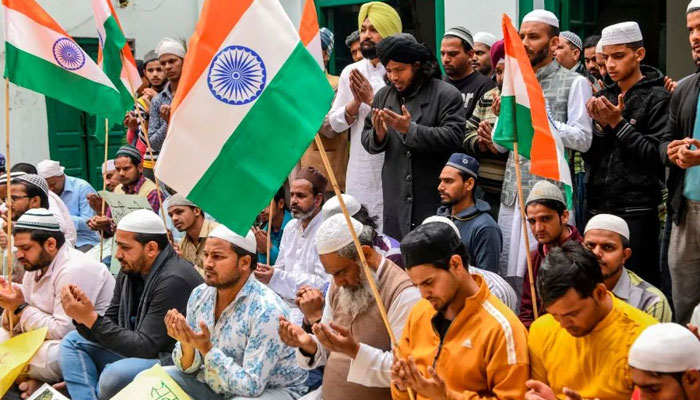

A seminary in Indian-occupied Jammu and Kashmir (IIoJK) is raided. A mosque in Gujarat faces demolition. A child in IIOJK is compelled to sing a song that violates his faith. A driver in Agra is forced to chant a Hindu slogan. These are not scattered incidents. Together, they tell a single, troubling story: in today’s India, religion is being weaponized and Muslims are paying the price. In IIoJK, religion is no longer protected, it is being prosecuted.
On November 27, 2025, Indian police and paramilitary forces carried out large-scale cordon-and-search operations across Islamabad, Pulwama, Budgam, Kulgam, Shopian and Kupwara districts. Dozens of houses linked to members of Jamaat-e-Islami were raided. Two major Islamic educational institutions, Jamia Sirajul Uloom in Shopian and Jamia Islamia Institute in Handwara, were stormed. Electronic devices, religious books and documents were seized. Authorities called it an investigation, but on the ground it is Islamic identity that now stands criminalized as a security threat.
On the same day, a 19-year-old boy in Jammu was arrested on the vague charge of being radicalised online. No clear evidence was presented. The arrest reflected a dangerous trend where suspicion replaces proof and faith itself becomes criminalized. This is what political analysts describe as securitization of identity, where an entire community is framed as a threat to justify repression.
This pressure is not confined to IIoJK alone. It mirrors a broader pattern unfolding across India. On October 4, 2025, the Gujarat High Court refused to stay the demolition of a part of the 400-year-old Mancha Masjid in Ahmedabad. Despite being a registered Waqf property and legally protected, the mosque was declared an obstacle to a road-widening project. The ruling sent shockwaves across the Muslim community. It reinforced a growing fear that even centuries-old religious structures are no longer safe under Hindutva-rule legality.
If courts legitimize exclusion and force raids normalize fear, then what remains of everyday safety? That question was answered brutally on November 27, 2025, when a video from Agra showed an elderly Muslim cab driver being forced to chant “Jai Shri Ram” under threat by Rohit Dharmendra Pratap Singh. The humiliation took place near the Taj Mahal parking area, a global symbol of India’s Muslim heritage. The humiliation was not random. It coincided with celebrations linked to the Ram Temple in Ayodhya, where Narendra Modi addressed devotees. For many Muslims, the timing symbolized how mob intimidation is being normalized under the banner of religious nationalism.

What happens when this climate enters classrooms? On November 5, 2025, authorities directed all schools across the territory to mandatorily recite “Vande Mataram” as part of official cultural programs. The order was called coercive and the practice was declared un-Islamic due to its conflict with Tawheed. The concern was not about patriotism, but about forced participation in a ritual that contradicted one’s religious beliefs. When the state compels children to perform faith-based expressions against their will, it ceases to be education and becomes ideological conditioning. Education, once meant to expand thought, becomes a tool to discipline identity.
The crisis deepened further on November 26, 2025, when religion was dragged into medical education. At the Shri Mata Vaishno Devi Institute of Medical Excellence, 42 out of 50 MBBS seats were secured by Muslim students purely on merit. Instead of celebrating academic excellence, Hindutva groups protested, arguing that Hindus should get priority because the institute is linked to a Hindu shrine. Warnings were issued that making decisions based on religion would destroy the constitutional fabric of India. The question, ‘Where will the Constitution go?’ now echoes across the region.
The raids, demolitions, forced chants, coerced schooling and faith-based discrimination in admissions form a structured ecosystem of pressure. Inside Kashmir, political leaders openly acknowledge that what is unfolding is nothing less than an assault on identity. A sitting Member of Parliament from Srinagar recently stated that a war is being waged against the language, religion, representation and existence of Kashmiris. He referred to the Public Safety Act (PSA) being used even against elected representatives and warned that fear is being used as a tool of governance. All these developments are rooted in the ideological project of the Rashtriya Swayamsevak Sangh and its political arm, the Bharatiya Janata Party. Their vision is to reshape India and Kashmir in particular, along rigid majoritarian lines. In IIOJK, this vision finds a testing ground where demographic engineering, cultural imposition and legal repression work together. What emerges is not integration but forced assimilation.
this trajectory is not merely a domestic human rights issue. It is a regional destabilizer. Internal ideological domination fractures social cohesion and deepens conflict asymmetries. The targeting of religion fuels alienation, deepens conflict and blocks any possibility of sustainable peace. A society where one faith is privileged by the state cannot remain stable. History shows that repression may silence voices temporarily, but it never erases resistance.
Today, Kashmiris are not only struggling for political rights. They are struggling to protect their mosques, their schools, their children and their dignity. The danger is not only to Islam in Kashmir, but to the very idea of religious freedom in South Asia. If forced chants, demolished mosques, raided seminaries and faith-based discrimination become the new normal, then democracy itself becomes a hollow word. When religion can be crushed so openly in IIOJK, it forces the world to confront a hard truth, the promises of freedom, pluralism and human rights are fragile. Kashmiris already live that reality, their loss of faith and dignity a daily reminder. And yet, for the rest of the world, silence allows this erosion to continue unchecked, turning inaction into complicity. If we fail to act now, today’s assault on belief could become tomorrow’s collapse of freedom for all.
The author is the head of the research and human rights department of Kashmir Institute of International Relations (KIIR). She can be contacted at the following email address: mehr_dua@yahoo.com, X @MHHRsays

Comments are closed, but trackbacks and pingbacks are open.