

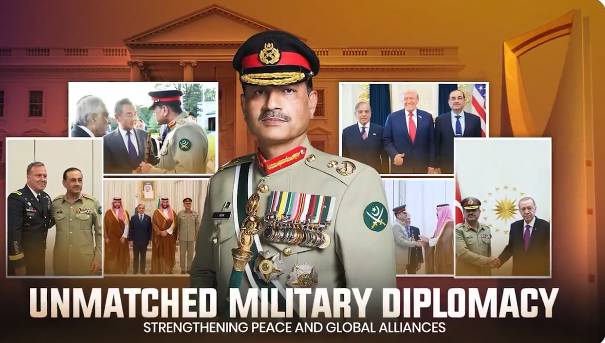
Financial Times Hails Field Marshal Asim Munir’s Multidimensional Foreign Policy
The analysis particularly highlighted his ability to adapt to the informal and unconventional diplomatic style

Islamabad: British newspaper Financial Times has described Pakistan’s Field Marshal Syed Asim Munir as a leading practitioner of multidimensional foreign policy, crediting him with steering the country through an increasingly complex global environment, reported on Tuesday.
According to the report, the Financial Times, in its analysis of shifting international politics, said Field Marshal Munir has emerged as one of the most effective strategic leaders in a rapidly evolving global order.
The newspaper noted that changing power dynamics have ushered in a new and challenging phase for middle powers, requiring careful balancing between competing global interests. In this context, it ranked Field Marshal Munir among the most successful proponents of multi-alignment diplomacy.
The analysis particularly highlighted his ability to adapt to the informal and unconventional diplomatic style of former US president Donald Trump, describing Pakistan’s approach as a clear and effective example of how middle powers can pursue flexible and pragmatic foreign policies.

The report also underscored Pakistan’s active engagement with key regional and global players, including Washington, Beijing, Riyadh and Tehran, noting that the country’s leadership has maintained parallel diplomatic tracks to safeguard national interests.
According to the newspaper, Field Marshal Munir capitalised on shifting global trends to create new diplomatic opportunities for Pakistan. It added that Pakistan’s timely and conciliatory engagement with Trump proved effective and led to diplomatic gains, in contrast to India’s experience.
Read more: KP Operations: 13 Terrorists Killed in Intelligence-Based Raids, ISPR Says
The analysis concluded that India struggled to adjust to changing global conditions and Trump’s unconventional style, which created difficulties in executing its own middle-power strategy.


Comments are closed, but trackbacks and pingbacks are open.