
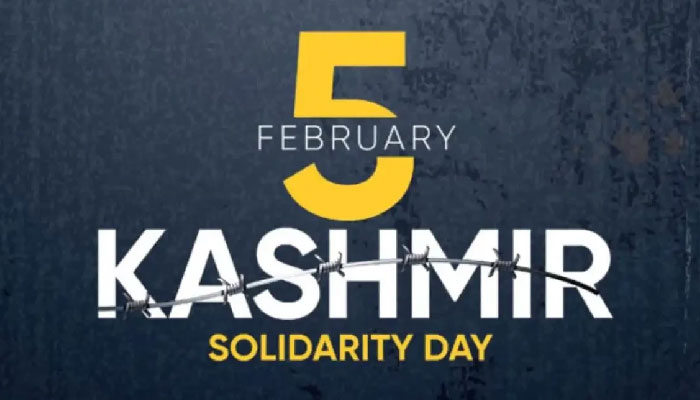

February 5 is not merely a date marked on the calendar; it is a living feeling, a collective consciousness, and the name of an ongoing pledge. It is the day that reminds us every year that the Kashmir issue is still alive, that the Kashmiri people are still being crushed under oppression and tyranny, and that the conscience of the world is still passing through a difficult test. This day is not confined to formal ceremonies, banners, or speeches; rather, it embodies a sense of responsibility that rests on the shoulders of all of us. Solidarity with the Kashmiri people is, in fact, solidarity with humanity itself—an affirmation of standing with truth and a powerful collective protest against injustice.
The history of the Kashmiri people’s struggle is filled with sacrifices. This struggle is not of a single day, a single year, or even a single decade; it is a pain passed down from generation to generation, a pain that continues to smolder in every Kashmiri heart. After the partition of the subcontinent, Kashmir emerged as an unresolved question—one that was further complicated by a combination of force, manipulation, and global indifference. The Kashmiri people were never granted the right that was promised to them on international forums. United Nations resolutions still exist, but their implementation has remained nothing more than a distant dream.
In occupied Kashmir, the manner in which Indian control has held human life hostage represents one of the darkest chapters of modern history. Streets, markets, schools, and places of worship—at one point or another—have all fallen victim to oppression. Pellet guns have robbed innocent children of their eyesight; young men have been martyred in staged encounters; political leadership has been kept behind bars for long periods; and entire regions have been cut off from the world through prolonged communication blackouts. All of this has occurred not during a declared war, but under the shadow of a so-called democratic state—one that the world hesitates not to call the largest democracy.
February 5 reminds us that this oppression is not solely the problem of the Kashmiri people; it is a question mark on the conscience of all humanity. If today an entire nation can be denied its fundamental rights, if state-sponsored repression can be normalized in one region, then tomorrow the same pattern can be repeated elsewhere. Therefore, the Kashmiri struggle is, in reality, the struggle of every human being who believes in freedom, justice, and dignity.
The relationship between Pakistan and Kashmir is not merely one of neighborhood or emotional attachment; it is a bond that is ideological, historical, and moral. From the very inception of Pakistan, the Kashmir issue became an integral part of our national priorities. For us, it is not just a diplomatic file—it is a living sentiment that beats in the heart of every Pakistani. February 5 is the day of renewing that sentiment, when the entire nation reaffirms its stand with the Kashmiri people and conveys to the world that Kashmir cannot be forgotten.
It is also a reality that over time, global politics has attempted to push the Kashmir issue into the background. Economic interests, defense agreements, and strategic partnerships often appear to outweigh the slogans of human rights. Global powers frequently display double standards: where their interests are threatened, human rights suddenly become important; where their interests are secure, the cries of the oppressed are conveniently silenced. Kashmir stands as the clearest example of this hypocrisy.
February 5 forces us to reflect on whether our solidarity is limited to just one day, or whether we truly wish to become part of this struggle. Have we ever paused to consider what a Kashmiri mother goes through when she watches her young son being taken into custody? What must a Kashmiri sister endure when the sanctity of her home is publicly violated? What impact does it have on the minds of Kashmiri children when, instead of schoolbags, they grow up seeing guns and military vehicles? These questions should disturb us—because unease is the first step toward true awareness.
The role of women in the Kashmiri struggle is also unforgettable. Kashmiri women have not only endured victimhood; they have set remarkable examples of resilience, courage, and resistance that deserve to be written in golden letters in history. The mothers who sacrificed their sons, the sisters who refused to bow before oppression, and the daughters who nurtured dreams of freedom even under the shadow of fear—all represent a face of the struggle that the world often ignores.
Kashmiri youth constitute the brightest yet most wounded aspect of this movement. This is a generation that has learned the meaning of freedom not from textbooks, but from lived experience. They have witnessed how curfews become routine, how the internet and phone services are shut down, and how asking questions is turned into a crime. Yet, despite all this, Kashmiri youth have kept their identity, determination, and hope alive. That is why, despite every tactic of repression, the voice of freedom has not been silenced.

February 5 also conveys the message that the Kashmir cause cannot be won through slogans alone. It requires sustained and serious efforts. We must strengthen our diplomatic front, present an effective narrative in international media, and maintain continuous engagement with human rights organizations. The world must be made to understand that what is happening in Kashmir cannot be classified as an internal matter; it is a recognized international dispute whose resolution is only possible in accordance with international law and United Nations resolutions.
At the level of the Pakistani people, commitment to Kashmir has always remained unwavering. Despite political differences, economic challenges, and internal issues, Kashmir is a point on which the entire nation appears united. February 5 symbolizes this national consensus. It reminds us that the promise we have made to the Kashmiri people is not merely a collection of words, but a moral obligation.
It is equally important that we educate our younger generations about the history and reality of Kashmir. Rather than limiting ourselves to emotional slogans, we must introduce them to facts, historical context, and the complex dimensions of global politics. Until our future generations truly understand this issue, we cannot lay the foundation for a strong and effective struggle. February 5 provides an ideal opportunity to pass on this awareness.
The Kashmir issue also teaches us that freedom is never granted without cost. Its price must be paid in the form of sacrifice, patience, and persistent resistance. The Kashmiri people have paid this price—and continue to do so. Their sacrifices give us the moral justification to stand with them, to be their voice, and to treat their pain as our own responsibility.
Finally, February 5 gives us the opportunity to renew our pledge that our solidarity with the Kashmiri people will not be confined to a single day. We will make it a part of our conduct, our conversations, our writings, and our practical actions. Because Kashmir is not merely a territory; it is an ideology—the ideology of freedom, justice, and human dignity.
This day reassures us that no matter how powerful oppression may seem, it never lasts forever. The wheel of history ultimately turns in favor of truth. The dawn of freedom for the Kashmiri people will surely arrive—and when that morning comes, February 5 will be remembered as the day when a nation declared its stand with the oppressed and transformed that declaration into a living pledge.

Comments are closed, but trackbacks and pingbacks are open.