

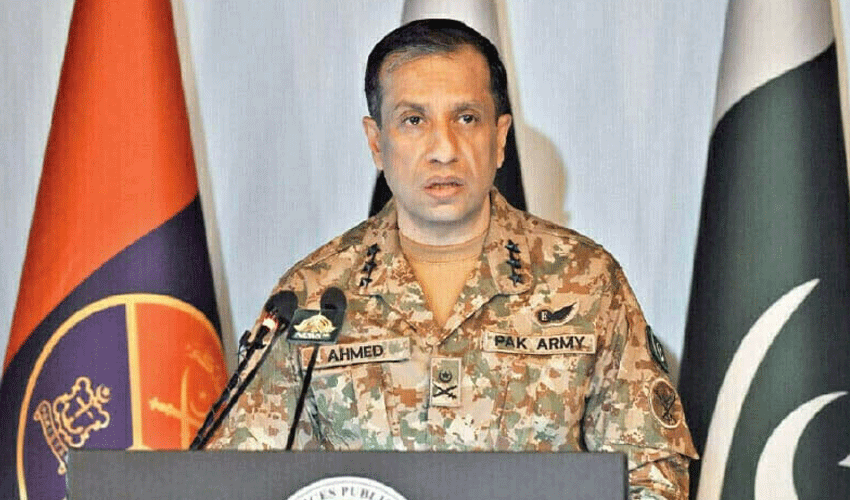

The recent, profound, and intensely detailed engagement that I was honored to participate in, specifically a comprehensive Talk Show broadcast across a prominent online media platform, was fundamentally and absolutely catalyzed by an extraordinary and meticulously planned press briefing delivered by the Director-General of Inter-Services Public Relations (DG ISPR). This singular event, by its sheer gravity and focused content, has not just influenced but has irrevocably shifted the entire national discourse in Pakistan into a critically severe and previously unprecedented realm of national security. The entire thrust, the central argument, and the comprehensive focus of the DG ISPR’s extensive and meticulously prepared address was dedicated exclusively and exhaustively to dissecting the complex personality and the ongoing, highly problematic conduct of the incarcerated founder of the Pakistan Tehreek-e-Insaf (PTI) political party, Imran Khan. This address was immediately recognized by political and security analysts across the entire spectrum as truly “unprecedented,” with people commentators marking it as a “historic GHQ press conference” precisely because of its direct and singular focus on the actions, statements, and psychological state of a major political figure. The DG ISPR did not mince words; he painstakingly articulated what he termed the highly problematic metamorphosis of Khan, stressing in categorical and unambiguous terms that the former premier’s political trajectory has dangerously deviated from that of a conventional, accepted political leader, transforming him into a clear, present, and undeniable “national security threat” to the Republic of Pakistan and its foundational constitutional institutions.
In a move that introduced a highly charged, almost clinical, element into the already intense national debate, the DG ISPR repeatedly employed specific terminology, labeling the former premier as an individual who is potentially “mentally ill,” suffering from a “delusional mindset,” and exhibiting the definitive characteristics of a “narcissist.” This carefully calculated, diagnostic framing was intended to communicate a profound and sobering professional assessment: that this individual’s actions are no longer driven by reasoned, rational political calculation, nor by a discernible political ideology, but rather by an all-consuming, pathological self-interest and an inflated ego that he genuinely believes must intrinsically supersede the vital interests of the entire state and the collective national good. This singular, self-centric belief, which serves as the core psychological malady, can be most concisely summarized as the destructive notion that “if it’s not him, then it’s nothing.” This belief system was presented as the fundamental psychological flaw that renders his entire political narrative an unacceptable and immediate danger to the constitutional structure and the essential national cohesion of the country. This profound psychological assessment underscores a critical, non-negotiable point: the issue, transcends the conventional boundaries of mere political opposition and enters the grave domain of an individual’s inability or fundamental unwillingness to differentiate between his own personal, boundless ambition and the fundamental requirements for the very survival and territorial integrity of the state.

My own resolute stance throughout the talk show discussion was firm and absolutely unambiguous: the DG ISPR’s entire communication was inherently and purposefully non-political in nature. Instead, it represented an absolutely essential, security-oriented intervention, one that was clearly necessitated by the alarming, palpable escalation of the political and civil situation witnessed across the country over the preceding months. Consequently, a pervasive, strong national consensus is rapidly solidifying among the vast majority of patriotic Pakistani citizens and independent security commentators. This consensus reflects the stark, unforgiving reality that Imran Khan has willfully and definitively abandoned the accepted, standard norms of democratic political leadership and now stands as an undeniable existential risk to the country’s stability and future. The horrific, destructive, and deeply anti-state incidents of May 9th, 2023, which Pakistan has formally designated as a “Black Day,” serve as the unassailable, publicly verifiable and comprehensively documented evidence of this perilous transformation. The extensive collection of video footages, photographic clips, and documented intelligence clearly demonstrates how a radicalized, violent faction of PTI supporters orchestrated widespread, coordinated riots, deliberately targeting and vandalizing crucial military and civilian installations. This egregious, anti-state behavior included the shocking and sacrilegious desecration of martyrs’ monuments—an act universally considered by the state and the populace alike to be the absolute height of anti-national betrayal and a profound dishonor to the immense sacrifices made for the nation’s defense. The functional, strategic impact of these orchestrated riots was, in every measurable and strategic sense, functionally equivalent to the subversive operations typically conducted by hostile foreign adversaries—a strategic act of internal self-wounding that rival nations like India or Israel had been historically unable to inflict upon the country over its entire 78-year existence. For the patriotic Pakistani and the rational security analysts, there is little functional or moral difference between the malevolent intent of these internal agitators and the intent of external enemies, as both exhibit a profound, active disregard for the integrity, institutions, and sovereignty of Pakistan. The events of May 9th were not an exercise in democratic politics or peaceful protest; they constituted a coordinated terrorist attack carried out by elements now firmly classified as anti-state. Critically, no sovereign nation on Earth can afford to grant political amnesty or freedom of operation to individuals who engage in or facilitate acts of terrorism; the very thought of allowing the perpetrators of events like the 9/11 attacks to participate freely in US politics underscores the sheer absurdity of the claims of political freedom being made for the May 9th rioters. Thus, it is abundantly and tragically clear to the nation that the operational tactics of the PTI have moved far beyond acceptable political boundaries and directly into the severe realm of national security threats.
The Army is believed as the protector of the nation, tasked with defending Pakistan from both internal and external threats. Actions against those seen as rioters, terrorists, or anti-state actors are taken as security responsibilities, not political interference. Imran Khan and PTI have moved beyond conventional politics, with their activities amplified through social media networks that allegedly spread harmful propaganda and may be influenced by hostile foreign actors. Efforts to distinguish criticism of a few military leaders from attacks on the institution are seen as disingenuous, and repeated inflammatory messages originating from Khan’s prison visitors are considered a destabilizing factor.
Khan’s behavior is obvious as driven by personal ambition and a “delusional mindset,” with PTI opposing key national security and policy decisions, including handling Afghan refugees and negotiating with terrorist groups. Recent security operations have reportedly shifted public opinion to strongly value national unity and a strong military, viewing any perceived threats to these pillars as betrayal. Events like the Marka Huq victory reinforced this perspective, fostering a collective resolve to guard against divisive narratives and maintain institutional loyalty. The DG ISPR’s press conference is therefore reflecting this widespread sentiment, resonating with those who prioritize the country’s stability and defense.

Comments are closed, but trackbacks and pingbacks are open.