

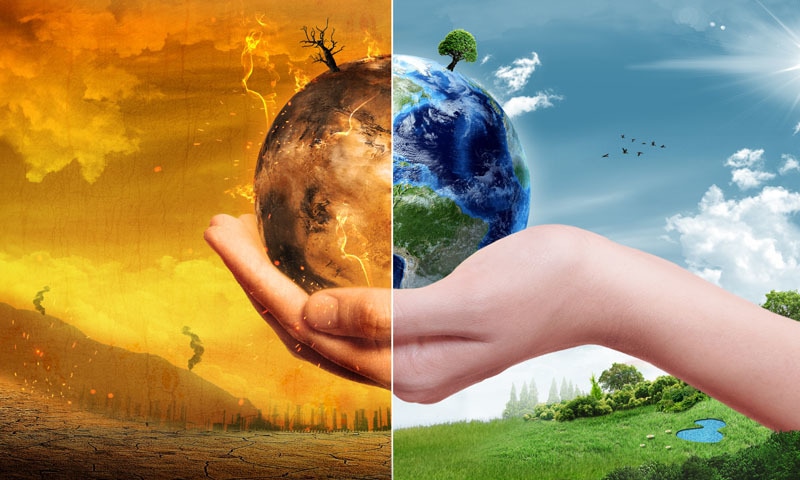

When the cool morning breeze of Islamabad brushes against the face, every inhalation seems to carry nature’s whispers. But who listens? We have long shut the windows leading to reason and awareness. In the northern mountains, glaciers weep silent tears; in the heartlands of Punjab, sprawling private housing societies pierce the earth like intrusive thorns; in Sindh, the land mourns the loss of its trees; and in the deserts of Balochistan, the scorching sun’s burden presses relentlessly on human shoulders. Yet, we stand by as spectators, applauding the spectacle. These are no longer mere natural phenomena—they are mirrors reflecting our own behaviors.
We began a war against nature—cutting down trees, poisoning rivers, wasting water and resources. And today, the Earth shakes us awake with its blow.
Yesterday, during a lecture at the Sustainable Development Policy Institute (SDPI), Dr. Adil Najam rightly emphasized that climate change is no longer merely a scientific issue. It has become a comprehensive crisis intertwined with human ethics, social values, and faith. In a country like Pakistan—where resources are limited and social consciousness is layered—the crisis serves as a mirror reflecting our shortcomings and negligence.
We embarked on a battle with nature in the name of development, forgetting that no one has ever truly triumphed over it. Technical solutions and administrative measures, though effective to some extent, are insufficient. Dr. Najam stressed, with unflinching intellectual rigor, that climate resilience now necessitates the harmonization of faith, ethics, and values with science. This is not mere advice—it is an undeniable practical reality. Religion forbids extravagance; we may profess belief in God, yet we ignore His commands.
I recall a report by SDPI researchers: in rural villages, women carefully collected rainwater in small tanks and reservoirs, while in cities, people left taps running wastefully. This stark contrast demonstrates that the solution to the climate crisis lies not solely in laws or technology, but in transforming human behavior—and such transformation is achievable through faith and ethics.
Dr. Najam illustrated the profound impact of faith-based behavioral change through the example of ablution (wudu). A typical ablution may use 3.5 to 10 liters of water, while the Prophet Muhammad ﷺ performed it using only 0.66 liters. If we adopt this principle of moderation in daily life, we not only conserve water but also learn the lesson of safeguarding natural resources. In Pakistan’s rural areas, where water is scarce, such practices are not a matter of choice—they are an urgent necessity.

Another undeniable truth emerges: viewing climate actions solely through the lens of economic benefit has proven insufficient. But when approached from human values, ethics, and faith, the impact intensifies. This lesson resonates in Pakistan’s rural societies, where land and water conservation are deeply intertwined with religious teachings and local traditions. By disregarding these principles and imitating Western models, we have widened the gap between policy and reality.
Dr. Najam also outlined seven fundamental principles derived from Islamic teachings that can serve as guiding lights for climate adaptation. These principles—covering sustainable resource use, waste reduction, environmental justice, and institutional reform—align perfectly with the goals of modern environmental policy. Adopting them in Pakistan is more critical than ever, as climate change directly affects the livelihoods of farmers, fishermen, and urban populations alike.
The political landscape further complicates the crisis. Governmental weaknesses, institutional fragmentation, and vested political interests often hinder environmentally conscious initiatives. Yet, by leveraging faith and ethics as practical and intellectual tools, we can foster behavioral change and exert pressure on policymakers to implement more environmentally responsible measures. This is not merely desirable—it is a political and intellectual imperative. The relentless rise in global temperatures repeatedly reminds us that time is running out.
During the Q&A session, Dr. Najam highlighted the growing engagement of Pakistan’s youth in value-driven climate activities. This is a beacon of hope. With education, awareness, and opportunities, the country’s young population can not only drive societal transformation but also enhance climate resilience at a national level.
Finally, it is clear that faith- and ethics-based strategies cannot replace state policy or international agreements. Yet they are a profoundly effective, though underutilized, means of fostering positive behavioral change. In countries like Pakistan, where political and economic crises pose ongoing environmental threats, working with local communities and individuals is indispensable. Faith, as a powerful social reality worldwide, can strengthen environmental protection and cultivate profound changes in human consciousness.
This moment is not merely about scientific reports or economic figures—it is a moral and political test. We must unite science, faith, and ethics in action, or this crisis will remain a bitter chapter in the annals of history. Pakistan’s mountains, rivers, and deserts cry out in silence, delivering one unmistakable message:“The time for action is now, and action must be illuminated by the light of faith.”
By Abid Rasheed


Comments are closed, but trackbacks and pingbacks are open.