

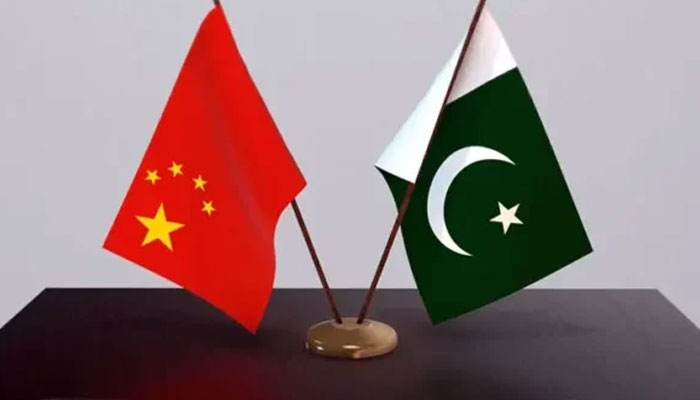
China-Pakistan Workshop Advances AI, Project-Based Science Education
Interactive Workshop Highlights AI, Creativity Through Challenges and Innovative Learning

Lahore: The second “Belt and Road” Youth and Science Teacher Capacity Improvement Workshop recently concluded, bringing together educators and students from China and Pakistan to explore artificial intelligence (AI) and project-based learning in science education.
The four-day offline workshop, held from December 10 to 14, was jointly organized by the Children & Youth Science Center (CYSC) of the China Association for Science and Technology and the Khwarizmi Science Society, a Pakistan-based non-profit promoting science education and culture. It followed six successful online sessions between November 26 and December 7, which engaged over 700 science educators and young learners from both countries.
The workshop focused on “AI-Empowered Subject Teaching” and “Project-Based Learning,” offering hands-on activities, school visits, and expert dialogues. The Chinese delegation visited Crescent Model Higher Secondary School and Lahore University of Management Sciences (LUMS), observing STEM classes and advanced research laboratories. Educators from both countries discussed energy development, engineering education, and educational innovation in a technology-driven era.

Read more: Pakistan Navy Launches Fourth Hangor Class Submarine GHAZI in China
Interactive sessions were a highlight of the workshop. In the “HAMSTER Interdisciplinary Challenge,” mixed teams of Chinese and Pakistani participants tackled tasks such as “Extreme Wheel” and “Spaghetti Racing,” combining creativity with engineering principles. Another session introduced generative AI as a tool for quickly creating teaching materials and enhancing curriculum design.
The workshop concluded with the “Xuanyuan Green Energy Vehicle Challenge,” where Pakistani students, guided by Chinese teachers, successfully assembled a functional electric vehicle. The test run of the student-built clean energy vehicle symbolized sustainable innovation and hands-on learning.
Ma Bin, a member of the Chinese teacher delegation, said, “Education is the foundation of people-to-people connectivity, and science and technology are the engines of innovation. We are honored to contribute to this cross-border collaboration, enabling educators from China and Pakistan to explore advanced ideas and share practical experiences. We look forward to more joint efforts and future development.”

Comments are closed, but trackbacks and pingbacks are open.