
CDWP Approves Rs160 Billion Development Projects
CDWP approves Rs160.2 billion projects to boost health, infrastructure, climate resilience, and inclusive growth across Pakistan for people nationwide development

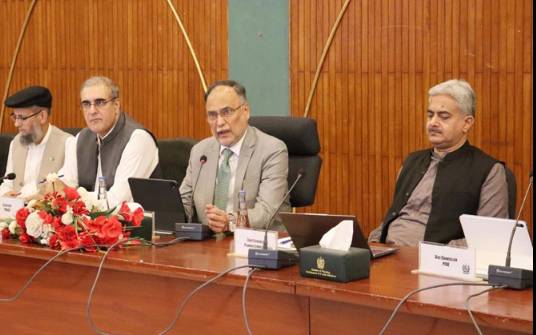
Islamabad – (Web Desk) – The Central Development Working Party (CDWP) has approved a series of development initiatives worth Rs160.2 billion during a meeting held in Islamabad on Friday, chaired by Federal Minister for Planning, Development and Special Initiatives Prof Ahsan Iqbal.
During the session, the forum assessed projects related to health, housing, physical planning, transport and communications. Two projects with a combined cost of Rs8.5 billion received immediate approval, while four major schemes worth Rs151.7 billion were forwarded to the Executive Committee of the National Economic Council (ECNEC) for final consideration.
Addressing the meeting, Prof Ahsan Iqbal stressed that development spending must align with national priorities and deliver clear improvements in human development, urban facilities and connectivity, especially in areas vulnerable to climate-related challenges. He reaffirmed the government’s commitment to ensuring that both federal and provincial projects produce long-term, sustainable socio-economic benefits.
In the health sector, the CDWP reviewed the Sindh government’s project titled “Sindh Human Capital Investment: 1,000 Days – Integrated Health and Population Programme,” with an estimated cost of Rs55.08 billion. The project, recommended to ECNEC, aims to enhance reproductive, maternal, newborn, child and adolescent health, along with nutrition and family planning services. It will be implemented by the Sindh Health Department, in coordination with the Population Welfare Department, and is proposed to be funded through foreign assistance.
The initiative focuses on improving human capital during the early stages of life, a period widely regarded as crucial for long-term economic growth and social development.
In the transport and communications sector, the CDWP approved the Hyderabad Urban Infrastructure Development Package, valued at Rs5 billion. Funded through the Public Sector Development Programme (PSDP), the project is expected to boost urban mobility, strengthen infrastructure and improve access to essential services for residents of the region.
Additionally, the forum discussed the Karachi Urban Infrastructure Development Package under the physical planning and housing sector and recommended it for ECNEC’s consideration.
Pakistan raises concerns over terror groups in Afghanistan
With a total cost of Rs15bn, the project will focus on priority infrastructure aimed at supporting the sustainable development of Karachi. The proposed interventions will cover multiple districts, including Karachi Central, East, South and West, as well as Korangi and Malir, and will be financed through the PSDP. The project is designed to address critical urban infrastructure gaps in Pakistan’s largest metropolitan centre.
Another major project recommended to ECNEC was the Emergency Flood Assistance Project – Sindh Works and Services Department Component, with a total cost of Rs60,054.590 million. The project will be financed through foreign funding, with 87 per cent provided by the Asian Development Bank and the remaining 13pc to be borne by the Government of Sindh through its Annual Development Plan.
The project covers several flood-affected districts, including Badin, Dadu, Hyderabad, Jamshoro, Kashmore, Larkana, Matiari, Mirpurkhas, Naushahro Feroze, Qambar Shahdadkot, Sanghar, Shaheed Benazirabad, Shikarpur, Tando Allahyar, Tando Muhammad Khan, Thatta and Umerkot. Its objectives include restoring and rehabilitating road infrastructure to ensure all-weather connectivity, improving access to markets and social services, reducing travel time and costs, and supporting agricultural and broader socio-economic recovery in flood-hit areas.

The CDWP approved the project titled “Improvement and Rehabilitation of BT Road from Liari to Lakhra and Uthal to Lakhra, District Lasbela,” to be executed in Balochistan at a cost of Rs3,515.067 million. The project, to be financed through the PSDP, aims to connect Lakhra tehsil with the district headquarters at Uthal and the Makran Coastal Highway.
Saudi Defense Minister Meets Pakistan Military Chief in Riyadh
The area was severely affected by floods in 2022, which disrupted mobility and economic activity. The rehabilitation of this road is expected to facilitate the transport of agricultural produce from Lakhra, an important agricultural hub, to markets, while improving access to education, healthcare and employment opportunities for local communities.
The meeting also considered the revised PC-I of the Winder Dam Project in Balochistan, with a total cost of Rs21,621.588 million, which was recommended to ECNEC.
The project will be financed through the PSDP, while land acquisition, command area development, security costs and provincial taxes will be borne by the Government of Balochistan. The dam is expected to contribute to water storage, irrigation development and improved water availability for agriculture and domestic use, thereby supporting livelihoods and enhancing resilience in the surrounding areas.
CDWP approved selection committee for Seerat Chairs. Under PSDP project, nine Seerat chairs are being established: Leadership and Governance, Human Rights and Justice, Education and Knowledge, Social Justice and Welfare, Global Peace, Inter-Faith and Communal Harmony, Business, Commerce and Property Rights, Sustainable Development, and Gender Studies and Women’s Rights.
Pakistan aims to strengthen ties with new Bangladesh government
The purpose of establishing Seerat Chairs is to develop a body of knowledge from Seerat Studies in light of contemporary challenges and issues.
The Planning Minister directed that the Digital Media Unit should be established in the Seerat Centre to acquaint the new generation with Seerat and informing global audience about the timeless teachings of the Prophet Mohammad and remove misconceptions about Islam. The Minister also directed that the selection of Seerat Scholars should be completed within three weeks.
Concluding the meeting, Prof Ahsan Iqbal reiterated that development planning would continue to prioritise projects that strengthen human capital, restore climate-resilient infrastructure, and promote inclusive growth.
He said the Planning Commission would closely monitor implementation to ensure timely execution and effective utilisation of public resources, in line with the government’s broader development and reform agenda.
Follow Daily The Destination Business on X , Instagram and Facebook for insights on business, finance and tech from Pakistan and across the world.

Comments are closed, but trackbacks and pingbacks are open.