

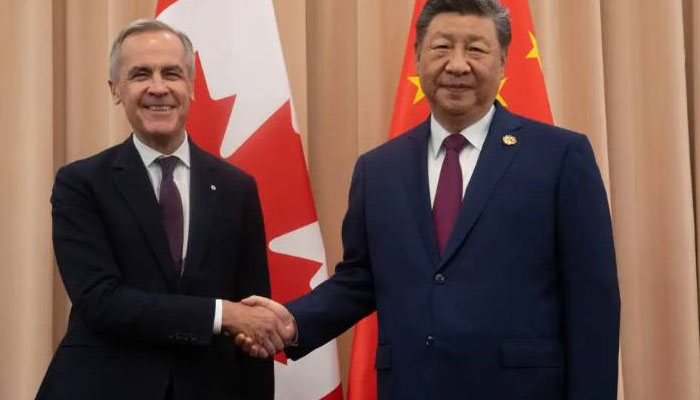
Canada’s Carney Seeks Reset with China in Beijing
Canada’s Mark Carney Meets Chinese Leaders to Rebuild Strained Relations

Beijing : (Web Desk) – Canadian Prime Minister Mark Carney is meeting senior Chinese leaders in Beijing on Thursday in a bid to reset relations between the two countries after years of diplomatic strain, as Canada looks to reduce its reliance on its traditional ally, the United States.
Carney is the first Canadian leader to visit China in eight years and has described the relationship as being at a “turning point.” His four-day state visit comes in the wake of aggressive tariffs imposed by US President Donald Trump on Canadian exports, prompting Ottawa to seek new economic partnerships beyond the US market.
Chinese state media showed Carney arriving in Beijing late Wednesday to a red-carpet welcome. He is scheduled to hold talks with President Xi Jinping, Premier Li Qiang, and senior government and business figures, with trade expected to dominate discussions.
Relations between Canada and China deteriorated sharply in 2018 following Canada’s arrest of a senior Huawei executive on a US warrant and China’s subsequent detention of two Canadians on espionage charges. Both sides later imposed retaliatory tariffs, affecting products ranging from Chinese electric vehicles to Canadian canola and agricultural goods, while Beijing also faced allegations of election interference in Canada.
However, signs of thawing have emerged under Carney’s leadership. He met President Xi at the APEC summit in October, after which Xi said bilateral ties were moving back onto “the right track.” Although talks to ease tariffs are ongoing, no agreement has yet been finalized.
Trump expects China to open its markets to USA goods
Traditionally aligned closely with Washington, Canada has been particularly affected by US tariffs on steel, aluminum, vehicles, and lumber. Carney has since called for doubling non-US exports by 2035. While the US still accounts for roughly 75 percent of Canadian exports, China remains a distant second, purchasing less than four percent in 2024—a gap Carney hopes to narrow through deeper engagement in trade, energy, agriculture, and global security.


Comments are closed, but trackbacks and pingbacks are open.