
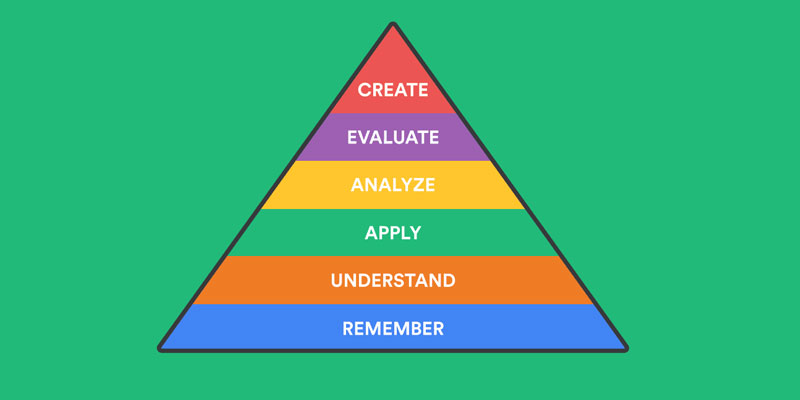

Developed in the 1950s by educational psychologist Benjamin Bloom, Bloom’s Taxonomy is a simple yet powerful framework that classifies learning into six levels of thinking—from basic recall to advanced creativity. For decades, it has guided curriculum designers across the world, offering teachers a clear roadmap for moving students from memorization to meaningful understanding.
In recent years, the term has quietly entered educational discussions in Pakistan, yet many still wonder: What does it really mean for our classrooms, and how can it improve traditional teaching?
To understand it, imagine a ladder with six steps. The journey begins with Remembering, then Understanding, Applying, Analyzing, Evaluating, and finally, at the top, Creating. These steps remind us that learning is a gradual mental progression—not merely the ability to recall information.
Interestingly, the first three levels of this taxonomy—Remembering, Understanding, and Applying—have already been incorporated into the examination structure of AJK BISE Mirpur at both secondary and higher secondary levels. This is a commendable step toward aligning assessment with modern educational standards. By embedding these cognitive levels into their papers, the board has set a positive example of how local examination systems can evolve to encourage genuine learning rather than rote reproduction. Their effort deserves appreciation, for it signals a meaningful shift toward quality assessment in the region.
Yet, despite such reforms at the assessment level, teaching in many classrooms remains confined to memorization. Students memorize, reproduce, and then forget, while the curriculum quietly expects that classrooms will help students climb to higher-order thinking. This gap between expectation and practice continues to hinder deeper learning.

The encouraging news is that applying Bloom’s Taxonomy in daily teaching does not require multimedia tools, costly resources, or formal training. It only requires a shift in how teachers ask questions. A teacher can transform a lesson simply by changing What is…? to Why did this happen…? or What would happen if…? These small adjustments lift students from one step of the ladder to the next.
Consider a typical textbook lesson. A teacher may ensure students remember facts, but a Bloom-aware teacher will also ask, “Why did the character make that choice?” or “How would the outcome change in a different situation?” The same content becomes more engaging, meaningful, and thought-provoking—without altering the textbook or adding new materials.
Teachers need not aim for all six levels every day. Junior classes can comfortably work within Remembering and Understanding, while middle classes gradually integrate Applying and Analyzing. Higher grades should routinely reach Evaluation and Creation. Even one higher-level question in a class can make learning richer.
The benefits are immediate: students participate more actively, learning feels less like memorizing, and teachers gain sharper insight into students’ abilities. Without any formal restructuring, teaching naturally becomes more effective.
Bloom’s Taxonomy is not a complex academic theory—it is a reminder that real learning is a step-by-step climb. When teachers offer the next step instead of repeating the same one, students develop into thinkers rather than rote learners.
In an education system often criticized for promoting cramming, Bloom’s Taxonomy offers a practical, classroom-friendly path toward meaningful understanding. With boards like AJK BISE Mirpur taking positive steps and teachers refining the way they question, our classrooms can nurture sharper minds and more confident learners—one thoughtful question at a time.


Comments are closed, but trackbacks and pingbacks are open.