


By: Dr. Ghulam Nabi Fai
Chairman
World Forum for Peace & Justice
February 23, 2026
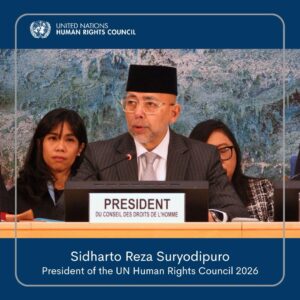
The United Nations Commission on Human Rights held sixty-two sessions in Geneva until it was replaced in 2006 by the Human Rights Council (HRC). The Human Rights Council is now holding its sixty-first session in Geneva, Switzerland under the presidency of Ambassador Sidharto Reza Suryodipuro of Indonesia, from today, February 23 to March 31, 2026, including consultations on enhancing international cooperation in the field of human rights.
In March 2005, then–UN Secretary-General Kofi Annan observed that “if the United Nations is to meet the expectations of men and women everywhere — and indeed, if the Organization is to take the cause of human rights as seriously as those of security and development — Member States should replace the Commission on Human Rights with a stronger Human Rights Council.” Later that year, 170 world leaders at the World Summit in New York endorsed this reform. Paragraphs 158 and 159 of the Summit Outcome Document clearly affirmed the Council’s mandate: to promote universal respect for human rights and fundamental freedoms for all; to address situations of violations of human rights, including gross and systematic violations; to make recommendations; and to mainstream human rights throughout the UN system.
Two decades later, however, the question remains: has the Human Rights Council fulfilled this mandate? Ambassador Annalena Baerbock, President of the 80th Session of the UN General Assembly, captured the lingering sense of disappointment on September 9, 2025, when she asked: “Where is the United Nations that was created to save us from hell? Where is the United Nations as conflicts spread, as our planet burns, as human rights are trampled?” She added, “We are not giving up. We are here. We see you… The world needs the United Nations.”
Yet experience shows that no human rights norm is self-executing. Until the international community recognizes a collective moral duty to assist victims of widespread human rights abuses — including through forceful or decisive measures — enforcement will remain inconsistent, selective, and driven more by politics than by principle. It falls to us to help catalyze that moral evolution.
Human rights defenders, many of whom risk their lives, liberty, and livelihoods, are indispensable to the UN system. Countless unnamed activists lie unrecognized in graves — a reality far beyond what justice should allow. The UN’s Special Rapporteurs understand well that such defenders are the backbone of accountability. For that reason, the idea of creating a limited international legal immunity — analogous to diplomatic immunity — for accredited human rights defenders deserves serious consideration.
Case in point: UN Special Rapporteur on the Situation of Human Rights Defenders, Professor Mary Lawlor (Irish national) described Khurram Parvez, an internationally known Kashmiri human rights activist as “a human rights defender, not a terrorist,” and condemned his arrest under counter-terrorism laws. In a March 2023 statement, Mary Lawlor, warned that Indian authorities were “intensifying the long-standing repression of Kashmiri civil society” through their actions against Khurram Parvez and others, and she urged the State to respect its human rights obligations and be held accountable where abuses occur.

Mary Lawlor also underscored that the Jammu and Kashmir Coalition of Civil Society (JKCCS) — the organization with which Khurram Parvez works — “carries out essential work monitoring human rights” and provides valuable research, including for international accountability efforts. Mary Lawlor’s statements on Khurram Parvez characterize him as a legitimate human rights defender, condemn the treatment he has faced under anti-terrorism laws, and call for respect of human rights standards and accountability.
International human rights covenant themselves also require strengthening. A major deficiency lies in the absence of meaningful enforcement mechanisms. The Universal Declaration of Human Rights states in Article 8 that “everyone has the right to an effective remedy by competent national tribunals.” But where constitutions do not protect fundamental rights, or where courts lack independence, that promise becomes hollow — especially under emergency or anti-terrorism regimes that block judicial review. Yasin malik
Prime example is that of Mohammad Yasin Malik, the most recognizable leader of Kashmir. The plan and intentions of the current fascist regime of India are more sinister when it comes to the case of Yasin Malik which is pending at the Supreme Court of India. Narinder Modi is using Yasin Malik as a pawn for his domestic agenda. To ameliorate his political standing, Prime Minister Modi is using concocted, cooked up and contrived cases against him. It should be noted that earlier Indian supreme court had rejected curative appeals for seeking death sentence for Yasin Malik. The trial court ruled that the case did not meet the Supreme Court’s “rarest of rare” threshold for capital punishment. Indian agencies are pursuing nefarious activities by conducting fresh raids after more than three and half decades to manufacture evidence to achieve their iniquitous goals.
It is therefore worth considering an amendment specifying that, at least for core rights — such as equality before the law, freedom of speech, religion, and association, protections against torture, slavery, and arbitrary detention — victims should have access to a civil damages remedy before the International Court of Justice, with no statute of limitations, no immunity defenses, and with universal enforceability of judgments in the domestic courts of all ratifying states. Nations should bear joint and several liability for abuses committed by their agents.
Accordingly, the Human Rights Council should consider creating an expert advisory committee to propose stronger civil-enforcement mechanisms for incorporation into international human rights treaties. A right without an effective remedy is worth no more than a generous gift written into a pauper’s will.
Candor compels us to admit that the UN has often fallen short when measured against its founding goals of peace, human rights, and self-determination. Kashmir remains one of the starkest examples of global inaction. After 1947, despite binding UN Security Council resolutions calling for a plebiscite, India renounced its commitment once it became clear that Kashmiris would not freely vote for accession to India. For more than seventy-nine years, grave and systemic violations in Kashmir — including extrajudicial killings, torture, rape, arbitrary detention, and enforced disappearances — have escaped sanction or meaningful moral censure. The silence surrounding Kashmir is not an exception — it is a symptom of a larger structural failure.
The UN is not without value. It has advanced norms and created spaces for dialogue. But progress measured in inches is no substitute for justice measured in lives. If the Human Rights Council is to matter, it must evolve from monitoring violations to enforcing accountability.
The world does not need a more eloquent United Nations. It needs a braver one.
Dr. Fai is also the Secretary General
World Kashmir Awareness forum.
He can be reached at:
WhatsApp: 1-202-607-6435 or gnfai2003@yahoo.com
www.kashmirawareness.org

Comments are closed, but trackbacks and pingbacks are open.