

Article by: Izmi Herlani
Nations are not secured by rhetoric; they are secured by resolve. From the earliest days of Pakistan’s statehood, the architects of its defence understood a stark truth: survival in a hostile neighbourhood demands mastery of the skies. It was not enough to possess aircraft; Pakistan required an air arm animated by conviction, sharpened by discipline and immune to coercion. The vision articulated by Muhammad Ali Jinnah was not poetic flourish—it was strategic foresight. An Air Force “Second to None” was not a slogan; it was an imperative. That imperative has shaped the institutional DNA of Pakistan Air Force. Over decades, it cultivated a culture where preparation is habitual and excellence is compulsory. Its officers, airmen and civilian staff were schooled to think beyond the immediate horizon, to anticipate rather than react, and to convert adversity into advantage. In this crucible of discipline, the modern PAF was forged.
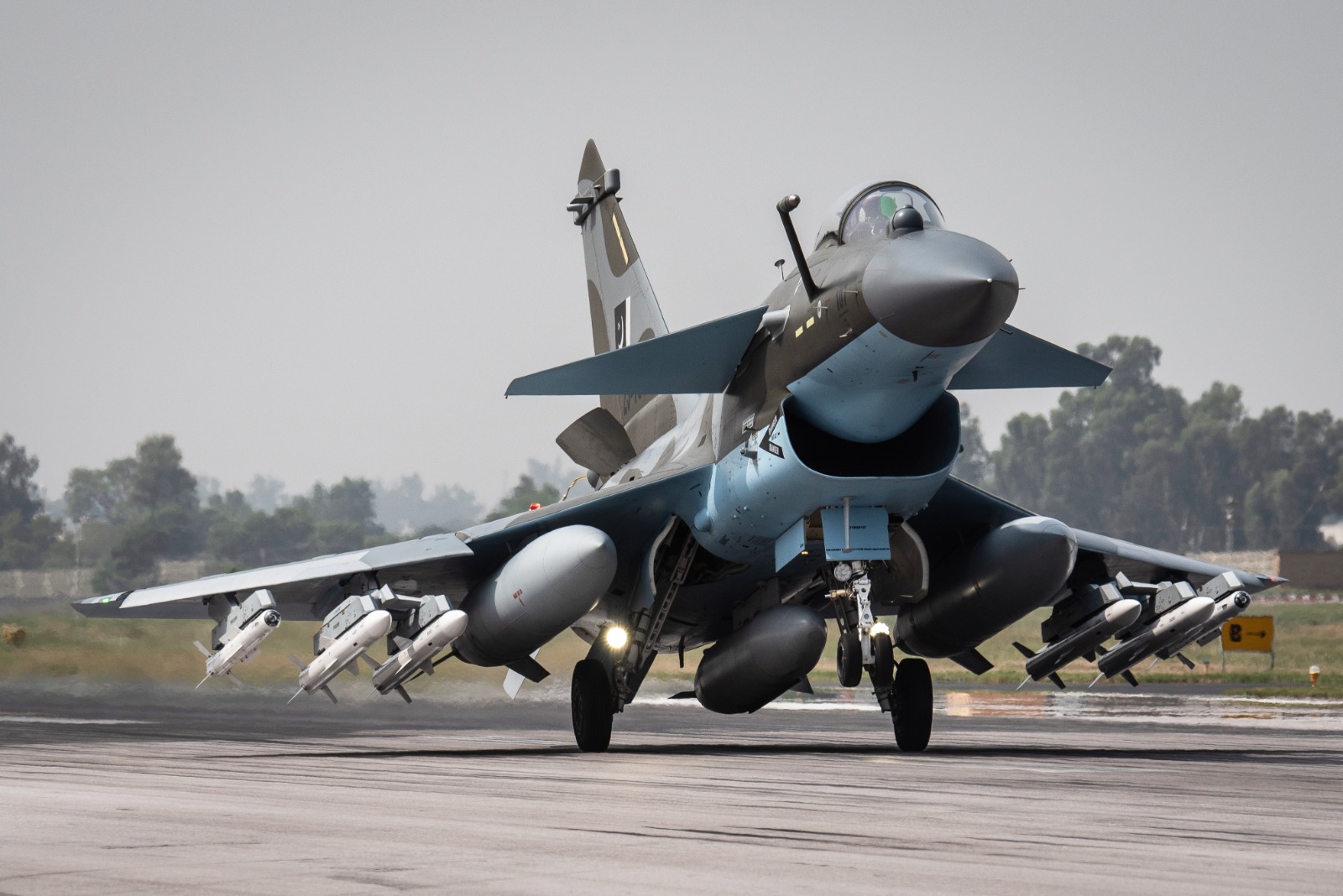
PAF showcases JF-17 and Super Mushshak at WDS
The world witnessed the manifestation of that ethos on 27 February, 2019 during Operation Swift Retort. Much has been written about that day, but its true significance lies beyond the headlines. It was not merely a retaliatory maneuver in a tense crisis; it was a calculated demonstration of credibility. In a matter of hours, PAF dismantled the illusion that escalation could be imposed upon Pakistan without consequence. Precision strikes, calibrated messaging and deliberate restraint combined into a seamless orchestration of power. The skies did not erupt in chaos; they were commanded with clarity.
Operation Swift Retort was, in essence, a doctrinal declaration. It signaled that Pakistan’s aerial shield was neither reactive nor brittle. It was agile, networked and confident. Years of quiet modernization, relentless training and operational introspection converged into a display of synchronized force. The message resonated far beyond the region: deterrence, when backed by capability and will, is unmistakable.
Yet Air Power, like history, does not stand still. The character of warfare has transformed with breathtaking speed. Today’s battlespace is not confined to altitude and speed; it extends into the electromagnetic spectrum, cyber corridors and orbital pathways. Recognizing this, PAF leadership has embarked this dynamic organization on a profound transformation; one that transcends hardware acquisitions and embraces conceptual evolution. Advanced combat platforms now operate as nodes within an interconnected ecosystem.
Unmanned systems complement manned aircraft; electronic warfare units contest invisible frontiers; cyber capabilities shield and probe simultaneously. Artificial intelligence augments decision cycles, compressing the time between detection and action. In this architecture, dominance is not achieved by numbers alone but by integration—by the seamless fusion of sensors, shooters and strategists into a unified Kill Chain.
This transformation was not theoretical. In May 2025, when confronted with renewed provocation, the PAF responded under unified command with a clarity that underscored its maturation. Multi Domain Operations unfolded with surgical precision. Adversarial assets were neutralized not in isolation but as part of a coordinated matrix of kinetic and non-kinetic effects.

The response was calibrated yet decisive, reaffirming that deterrence remains credible only when it is demonstrably enforceable. What distinguishes the contemporary PAF is not merely its inventory but its intellectual capital. Technology, however advanced, is inert without mastery. The lifeblood of air power remains training; rigorous, unforgiving and continuous.
From basic flight instruction to high-end multinational exercises, PAF air warriors are conditioned to operate in complex, contested environments. They are trained to absorb ambiguity, to make split-second decisions under immense pressure and to execute with clinical accuracy. Education and innovation are no longer peripheral pursuits; they are strategic enablers.
PAF Leadership Development programs cultivate commanders who are as comfortable with algorithms as they are with aerodynamics. Exposure to international best practices broadens horizons, while indigenous research grounds ambition in national capability. This synthesis of global insight and local ingenuity has ensured that PAF remains adaptive in an era defined by disruption.
Parallel to operational refinement runs a determined march toward self-reliance. For too long, developing nations have equated security with dependence. Pakistan has chosen a different path. Through a burgeoning aerospace ecosystem and expanding science & technology parks, the foundations of sustainable air power are being laid at home. Indigenous maintenance, avionics upgrades and system integrations are reducing vulnerabilities while strengthening strategic autonomy.
Self-reliance is not isolation; it is resilience. By embedding innovation within national industry, PAF under the astute command of Air Chief Marshal Zaheer Ahmed Baber is cultivating a virtuous cycle—military requirements stimulate technological growth, which in turn enhances national capacity. The dividends extend beyond defence, invigorating sectors that underpin economic vitality and scientific advancement.
Seven years after Swift Retort, the security of Pakistan’s skies rests not on chance but on determination of our Men & Women in Blues. PAF stands today as a fully integrated,
Multi-Domain Force capable of shaping outcomes across the spectrum of conflict. Its doctrine is refined in peace, validated in crisis and informed by the unyielding pursuit of excellence. Deterrence, however, is a dialogue.
It communicates through capability and credibility. PAF’s recent operations have reiterated that Pakistan’s sovereignty is neither negotiable nor vulnerable. PAF leadership has ensured that by development of it’s home grown Kill Chain any miscalculation by the adversary will encounter swift correction. The calculus for any adversary is therefore stark: escalation invites consequences that are immediate and proportionate.
Air power is as much about spirit as it is about steel. Aircraft may patrol the skies, but it is conviction of our Shaheens that anchors them. Pakistan Air Force embodies a tradition where professionalism is sacred, preparation is perpetual and patriotism is instinctive. It has evolved from a force that answered challenges to one that shapes the strategic environment.
From Operation Swift Retort to Marka e Haq and beyond, PAF’s journey has been neither accidental nor easy. It has been earned through sacrifice, foresight and steadfast resolve. As regional dynamics grow increasingly complex, one reality endures: the guardians of Pakistan’s skies remain vigilant, capable and unbowed. For a nation that values its sovereignty, that assurance is priceless.


Comments are closed, but trackbacks and pingbacks are open.