
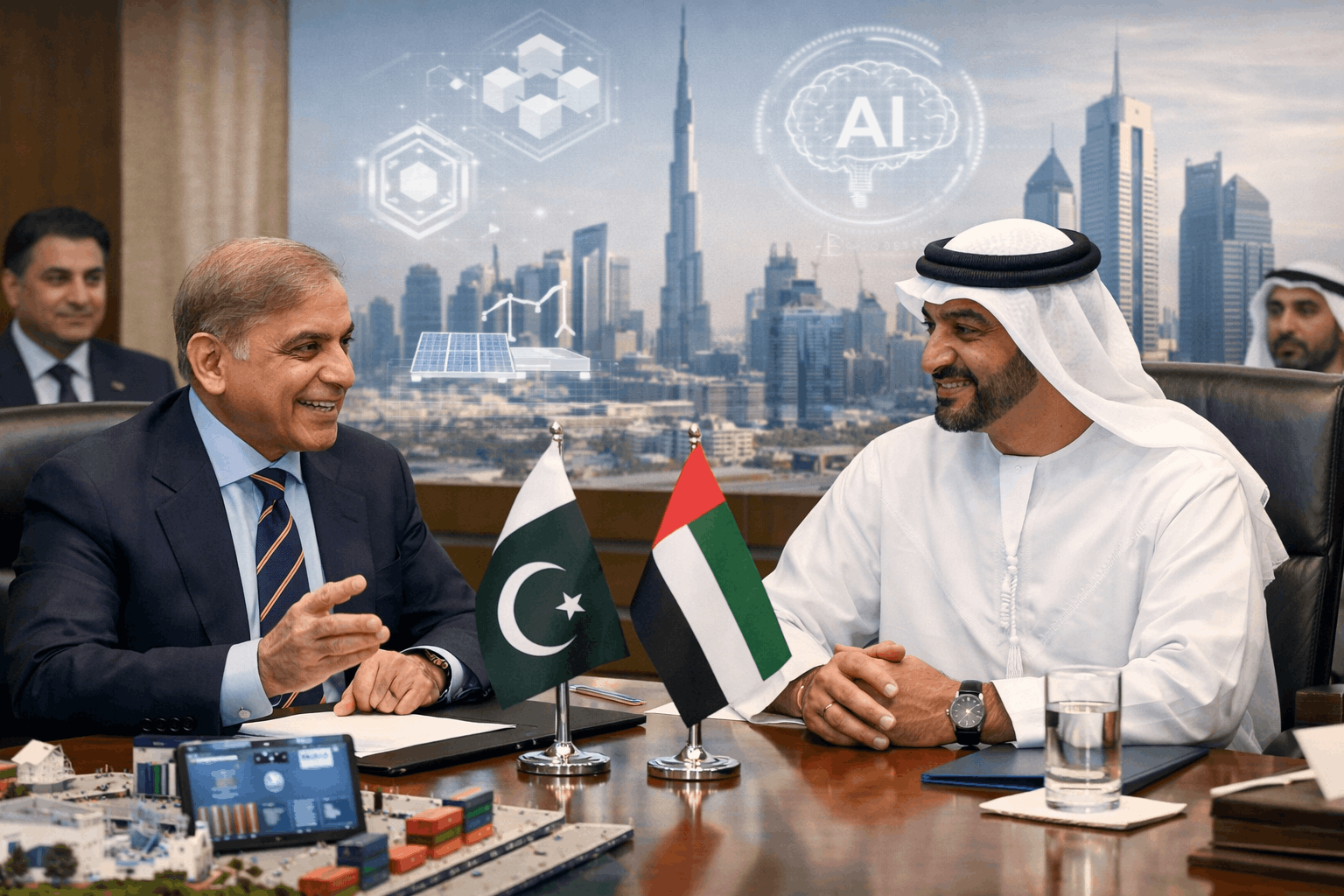
Beyond Remittances: The Strategic Pivot in Pakistan-UAE Relations
Pakistan and UAE strengthen strategic partnership, focusing on high-tech investments, skilled workforce, and sustainable economic and energy collaboration.

By Eiman Basharat
The Pakistan–UAE relations have evolved from initial recognition and early development support to a multidimensional partnership that includes economic, defence and strategic collaboration. This progressive development highlights the shifting regional dynamics and interests. With these shifting dynamics, Pakistan’s interest also shifted from aid to high-tech investment and infrastructure ownership. Islamabad seeks to sell its defence technology to the UAE and is also seeking to align its domestic Digital Pakistan Vision with the UAE’s high-tech pivot.
The relations between states are constantly evolving, and the relationship between Pakistan and the UAE is currently experiencing a fundamental shift. On January 9th 2026, the meeting between PM Shehbaz and the Sajwani Group proved that the old days of emergency rescue are over. They discussed more than just aid and highlighted future implications, including AI, blockchain, and tech-driven business. On January 20th, 2026, both states reviewed their economic ties and agreed to further strengthen investment-led cooperation during a meeting at the World Economic Forum. This isn’t just about brotherly feelings anymore; Islamabad has stepped forward, where our young talent has to step up and match the high-speed energy of the UAE’s modern economy.
Pakistan International Airlines provided technical and administrative expertise to the UAE, and it helped launch Emirates in 1985. These bilateral engagements of states have transformed from institutional mentorship into a strategic economic alliance. Pakistan served as the institutional backbone of the newborn state.
By the early 2000s, the UAE had moved beyond mere diplomacy to become Pakistan’s ultimate economic safety net. UAE Pakistan Assistance Program (UAE-PAP) was another multifaceted humanitarian and development initiative launched in 2011. Scholars believe that this was a masterclass humanitarian program, but this has pushed Pakistan into a dependency trap. By converting sovereign debt into industrial equity, Islamabad is finally moving beyond the diminishing returns of goodwill toward a hard-nosed, investment-driven reality.
According to a report by the UAE’s Ministry of Foreign Trade, the UAE’s public and private sectors invested $10 billion in Pakistan in the last two decades. Abu Dhabi Group (AD) is enhancing regional connectivity and fostering economic growth in Pakistan by signing a Memorandum of Understanding (MOU) with the Karachi Port Trust (KPT). This deal was made in 2023 to bolster both states’ berths and develop the trade and logistics capacity. The UAE is Pakistan’s largest trading partner in the Middle East. Both states have made progressive shifts into deep economic partnerships, represented by cross-border impartial acquisitions for mutual development.

The recent state visits have sparked bilateral cooperation by shifting relations towards a more formal strategic partnership, regional concerns and interests. These partnerships have increased in recent years, as seen in the recent December 2025 visit, when the President of the UAE and the Ruler of Abu Dhabi, Sheikh Mohammad bin Zayed, visited Pakistan.
Pakistan must proactively contribute to the UAE’s 2031 pillars by providing high-efficiency talent required for a Forward Economy and supporting the regional stability central to Forward Diplomacy. The UAE is seeking significant talent from Asia to meet its targets of raising GDP by AED 3 trillion. The UAE now seeks professionals and problem solvers rather than just more workers. Strategic and regional competitors of Pakistan, such as India, hold prominent positions, transforming their workforce from low-skilled workers into high-skilled professionals in healthcare and engineering.
By matching its training to the UAE’s Skill levels 1 through 3, Pakistan can meet their demands by guaranteeing that its employees possess certified degrees and specialised certifications. Pakistan can help the UAE meet its food security demands by utilising SIFC to support corporate farming headed by the UAE. As a result of this development, the collaboration will mark Pakistan as a strategic partner instead of a labour provider.
UAE rolls over $2bn Pakistan loan before IMF review
Beyond remittances, the UAE can be a strategic partner in addressing Pakistan’s energy security concerns. Pakistan is facing a serious power shortage, while ECO is a regional platform for energy cooperation; bilateral relations with an energy-rich country like the UAE are equally important. The UAE’s economy, driven by oil production and non-oil sectors, continues to perform strongly, making it a reliable energy partner. Pakistan can aim for a similar deep-rooted strategic alliance with the UAE to bolster its energy supplies and infrastructure.
In conclusion, as the prevalence of high-level state visits increases, these collaborations are gaining diplomatic momentum between Pakistan and the UAE. The recent fast-tracking of the Comprehensive Economic Partnership Agreement can lead to sustainable strategic partnerships. Pakistan has a golden opportunity to promote digital business-to-business partnerships and upgrade and institutionalise its Value-Added policies towards the UAE. A trained and skilled Pakistani labour force might boost yearly remittances, thereby stabilising national reserves and reducing the nation’s long-term reliance on foreign debt.
Saudi Defense Minister Meets Pakistan Military Chief in Riyadh


Comments are closed, but trackbacks and pingbacks are open.