
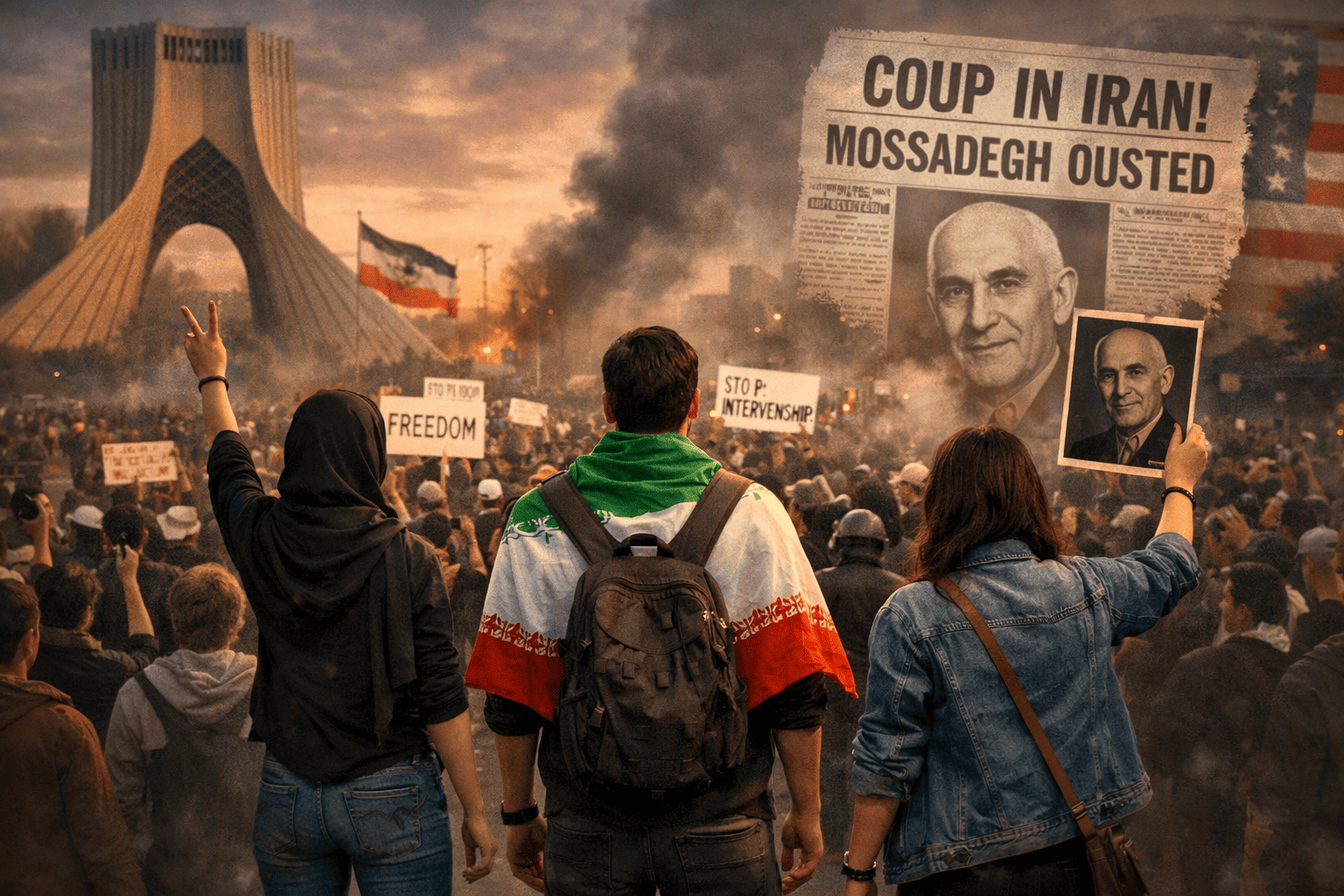
Between the Lines from Mossadegh to Today’s Protests: Iran, Regime Change, and Lessons from History
Iran’s protests reflect deep economic pain, historic distrust of foreign intervention, and demands for dignity, reform, and self-determined change today.

By: Professor Imran Ismail Chohan
The ongoing protests in Iran cannot be seen merely as temporary public reactions. On the surface, they appear to be against inflation, unemployment, social restrictions, and political stagnation. Yet beneath these protests lie complex threads of power, authority, and global politics that have repeatedly shaped modern Iranian history. The issue becomes even more sensitive when U.S. leaders assert that “we will go into Iran to protect protesters,” raising the question: is this genuinely humanitarian concern, or is it a pretext for another attempt at regime change?
The current protests in Iran have deep-rooted causes. First and foremost are economic difficulties. U.S. sanctions have put Iran’s economy under severe pressure, inflation has made daily life difficult, and youth unemployment has risen. In addition, restrictions on social freedoms, violations of women’s rights, and limited political participation have placed the public under constant social and emotional pressure. These factors have driven people to the streets, demanding better jobs, transparent governance, dignity, and freedom.
The problem arises when external powers attempt to exploit these protests for their political and economic interests. Recent U.S. statements about “protecting protesters” are highly sensitive in light of history. For many Iranians, any external involvement in domestic protests risks turning a legitimate struggle into a tool for foreign agendas. History provides a clear lesson, particularly the events of the 1950s in Iran.
In 1951, the elected Prime Minister, Dr. Mohammad Mossadegh, made a bold move by nationalizing Iran’s oil industry. Through this action, Iran gained sovereignty over its oil, which until then had been controlled by British companies, especially the Anglo-Iranian Oil Company. This decision was extremely popular domestically, as it symbolized national pride and independence. However, it was unacceptable to Britain.
Initially, the British government imposed economic sanctions, exerted diplomatic pressure, and tried to isolate Iran internationally. When these measures failed, Britain turned to the United States for help. In the Cold War context, the U.S. was warned that if Mossadegh remained in power, Iran could fall under communist influence or Soviet sway. Consequently, in 1953, a joint U.S.-British operation orchestrated a coup that removed Mossadegh and restored the Shah to full authority.
This political episode left profound consequences on Iran’s society, politics, and international relations. The overthrow of a democratically elected government strengthened authoritarian rule, creating deep distrust among Iranians toward the West, especially the U.S. and Britain. This mistrust eventually culminated in the 1979 Islamic Revolution, which overthrew the Shah and established a new ideological state in Iran.
Today, as protests unfold and some U.S. leaders speak of “protecting protesters,” many Iranians recall the 1953 coup. They understand that external involvement in domestic politics can not only harm internal processes but also hijack them for foreign agendas. Even critics of the current regime are wary of such intervention.

The concept of regime change, particularly through foreign powers, has almost always been disastrous. Examples from Iraq, Libya, and Afghanistan demonstrate how interventions, under the banner of “democracy” and “human rights,” destroyed state structures. Iran faces the same risk. External pressure often strengthens hardline elements within the country, who can then suppress dissent under the pretext of combating foreign interference.
It is also important to acknowledge that the issues Iranian citizens face are genuine and require solutions. History, however, shows that sustainable change does not come from outside—it must emerge internally. If reforms are to succeed, they must come through local political processes, social awareness, and grassroots pressure. Foreign “assistance” has often proved more harmful than helpful.
Moreover, the active participation of Iran’s youth in current protests is significant. This generation is more educated, globally aware, and sensitive to social justice. They demand not only economic improvement but also social freedoms, women’s rights, and political transparency. Supporting their demands is crucial, but the support must allow Iranians themselves to chart their path, not under the guidance or influence of foreign powers.
From Mossadegh to today’s protesters, one lesson repeats itself: whenever Iran asserts its sovereignty, foreign powers have perceived it as a threat. Whenever external interference occurs, it deepens the wounds of the Iranian people. Understanding the historical continuity is essential to comprehend today’s protests.
History may not repeat itself verbatim, but its patterns endure. The slogans echoing through Iran’s streets today carry the weight of yesterday’s struggles. If human rights and freedom are truly the goal, the primary principle must be that Iranians themselves decide their future, not external powers. The role of foreign powers should be limited to observation and moral pressure through international human rights bodies, not intervention or engineered regime change.
The story of Mossadegh and the ongoing protests remind us that independent and sovereign decisions can be destroyed by external pressure, but internal awareness, social struggle, and local reforms are the true guarantors of lasting change. The Iranian people’s struggle is based on this principle, and if they determine their own destiny, it could lead to genuine revolution.
The greatest lesson for Iran’s future is that development, democracy, and human rights are more sustainable when pursued internally, and history repeatedly shows that foreign intervention often proves detrimental.
Pakistan, UAE Agree to Deepen Investment-Led Economic Cooperation at WEF
Comments are closed, but trackbacks and pingbacks are open.