
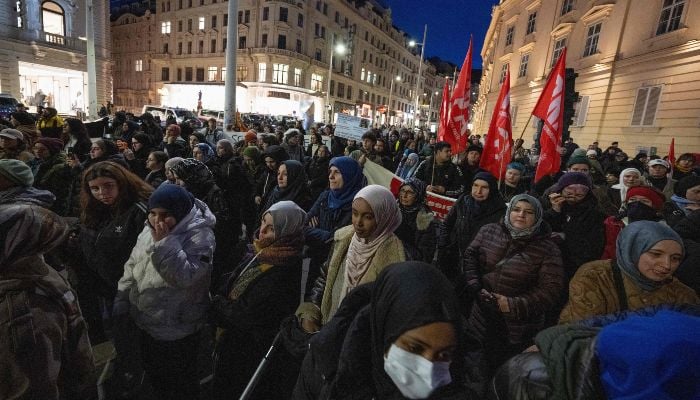
Austria’s new law banning headscarves in schools sparks widespread anger
Young Muslim Girls Caught in the Middle of Austria's Heated Political Debate Over Religious Freedom in Schools

Austrian School – (Web Desk) – A new Austrian law banning girls under 14 from wearing headscarves in school has left many Muslims feeling uneasy, hurt, and afraid that they are being increasingly singled out across Europe.
Austrian parliament passed the measure back in December, and it is due to come into force when the new school year begins in September.
With concerns about immigration running high across the country, the ruling conservative government says the law is meant to shield young girls from being pressured or oppressed. However, human rights organizations and legal experts strongly disagree, arguing the law is discriminatory, could tear communities further apart, and may not even hold up in court.
At a protest in Vienna last month, a 12-year-old girl put it simply and powerfully. “It’s my decision,” she told reporters. “Nobody can make me wear a headscarf, and nobody can make me take it off.” She chose not to share her name.
The government believes around 12,000 girls will be directly affected, though some experts feel that number is overstated. For context, roughly one in twelve people living in Austria identifies as Muslim, based on figures from 2021.
Schools have already received detailed guidance from the education ministry on how to apply the new rules. Teachers are required to ask any girl wearing a headscarf to remove it. If she refuses, the matter must immediately be reported to school management, who must then meet with the student and her parents or guardians.
Families whose children repeatedly refuse to comply could face fines of anywhere between 150 and 800 euros. Even teachers and school leaders who fail to enforce the rules could face legal trouble.
One Vienna-based teacher, who preferred to stay anonymous, said she has no intention of following through. She called it “a populist move” that sidesteps the real issue — parents of any faith using pressure or harm against their children.

Last month, hundreds of people gathered in central Vienna to march against the ban, eventually making their way to the government’s headquarters.
Malika Mataeva, who co-founded the Muslim Women Network, spoke with deep emotion about what she described as “years of deep-seated racism in Austria.” She said the ban is yet another reminder that enough is enough, and that freedoms that should be guaranteed are simply not being honored.
Austria has historically welcomed immigrants and people seeking refuge from conflict. Yet hostility toward newcomers has grown sharply in recent years. In the 2024 national elections, the far-right Freedom Party came in first — a historic milestone — though it ultimately was unable to form a government. A major European rights report from the same year found that Muslims in Austria face the worst rates of racism and discrimination across the entire EU.
Austria’s official Muslim representative body, the IGGOe, has announced plans to take the law to court. This is not the first time something like this has happened — a similar headscarf ban covering primary school children was introduced in 2019 but was later struck down by Austria’s constitutional court.
Austria’s equal treatment watchdog has been equally direct, stating clearly that the law unfairly targets one specific religious practice and is very likely unconstitutional.
Explosions rock areas near Pakistan’s embassy in Tehran
At the Vienna rally, an 11-year-old girl named Hadiya said she is the only student out of 27 in her class who wears a headscarf. “I’m angry,” she said. “I don’t see any good reason for this ban.”
A mother attending the same protest shared how the uncertainty has weighed on her two daughters, aged 11 and 13, both of whom are reluctant to remove their headscarves. “They say it’s for the girls’ protection,” she said quietly, “but my daughters have been anxious and upset for months, not knowing what to do.”

Comments are closed, but trackbacks and pingbacks are open.