

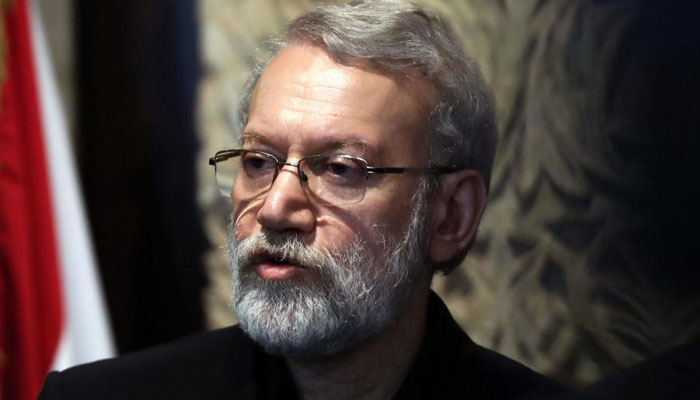
Ali Larijani killed in Israeli airstrike, Iran says; son Morteza also dead

Tehran-(Special Correspondent/Web Desk)-Iranian authorities confirmed on Tuesday that the country’s security chief, Ali Larijani, has been killed, with state media describing his death as martyrdom. Earlier in the day, Israeli officials, including Prime Minister Benjamin Netanyahu, had announced that Larijani died in an Israeli strike. In a televised address, Netanyahu suggested that Larijani’s death could create an opportunity for Iranians to challenge their current leadership.
Known for combining ideological commitment with pragmatic policymaking, Larijani played a central role in shaping Iran’s nuclear strategy and diplomatic direction. At 68, he was widely regarded as a calm and calculated figure, trusted by the late Ali Khamenei, and had an extensive career spanning military service, media leadership, and parliamentary politics.
Ishaq Dar Meets Iranian Envoy, Discusses Regional Peace
In June 2025, after Iran’s war with Israel and the US, he was appointed head of Iran’s top security body, the Supreme National Security Council, a position he had held nearly two decades earlier, coordinating defence strategies and overseeing nuclear policy.
He later became increasingly visible in the diplomatic arena, travelling to Gulf states such as Oman and Qatar as Tehran cautiously engaged in negotiations that were ultimately scuppered by the war.
Born in Najaf, Iraq in 1957 to a prominent Shia cleric who was close to the Islamic republic’s founder Ayatollah Ruhollah Khomeini, Larijani’s family has been influential within Iran’s political system for decades.
He earned a PhD in Western philosophy from the University of Tehran.
A veteran of the Islamic Revolutionary Guard Corps during the Iran-Iraq war, Larijani later headed state broadcaster IRIB for a decade from 1994 before serving as parliamentary speaker from 2008 to 2020.
Israel claims Iran’s security chief killed in strike
The reported assassination of Larijani marks another shock to Iran’s leadership after the joint US‑Israeli strikes on 28 February that killed the country’s supreme leader, Ayatollah Ali Khamenei.

His son and successor, Mojtaba Khamenei, has not been seen publicly, prompting speculation about his condition. Russian Presidential press secretary Dmitri Peskov, quoted by the official Russian Tass agency, said Moscow would “not comment” on a report in a Kuwaiti newspaper that he had been flown to Moscow for medical treatment.
Explosions shook Tehran overnight as Israel said it hit “Iranian terror infrastructure” in the capital and elsewhere.
In Lebanon, dawn air strikes targeted Beirut’s southern suburbs, Hezbollah’s main stronghold, reportedly leaving buildings ablaze and debris littering the streets.
Authorities in Lebanon say more than one million people have been displaced since early March, with many now sheltering in makeshift centres.
Western allies – including France, Germany and Britain – have urged Israel to limit its operations, warning of regional collapse.
EU rejects Trump request to join Strait of Hormuz mission
Iran has retaliated with attacks on US interests and Gulf infrastructure, including tankers in the Strait of Hormuz, disrupting a fifth of global oil traffic and driving prices higher.
The United States has called on its partners to join a naval coalition to secure the waterway, but enthusiasm has been muted.
British Prime Minister Keir Starmer said he was working “with allies on a viable plan” to reopen the strait while rejecting a NATO‑led mission. Germany echoed that view, warning that the alliance should not be drawn into Washington’s war.
Meanwhile, Iran’s health ministry says at least 1,200 Iranians have died in US and Israeli strikes since the start of the conflict.
In neighbouring Iraq, rockets targeted the US embassy early Tuesday, forcing air defences into action over Baghdad’s heavily fortified Green Zone.


Comments are closed, but trackbacks and pingbacks are open.