

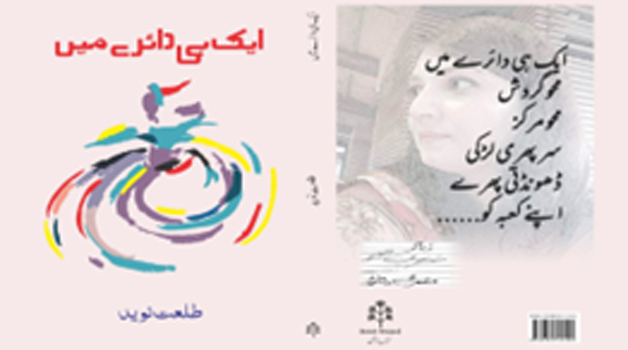
‘Aik He Dairay Mein’: Poetry of a woman’s Plight, Fight and Flight…
Poetry: Aik He Dairay Mein ,By Tallat Naveed

Book Review ,Publisher: Kitab Trinjan ,Reviewer: Tahseen Tahir
‘Aik He Dairay Mein’, the first poetry collection by Tallat Naveed, offers vivid glimpses of the poet’s own realm and her perception of the world around her. She weaves a tapestry of life’s journey through poetic diction, displaying feelings of tenderness and strength, deprivation and fulfillment. Her poetry also explores a conscious person’s concern over the grave occurrences plaguing individuals and society.
The book is published by Kitab Trinjan. It contains 70 blank verse poems and 10 ghazals. The poetry is adorned with the use of similes and metaphors.
The title ‘Aik He Dairay Mein’ introduces us to the arena of a woman’s life, circling within the imposed boundaries of fitting into conventional gender roles. Women are constantly compelled to embrace certain actions, attitudes and roles by society; these undesirable objectives clip their wings to think and act independently and discover their potential.
Tallat has undergone ups and downs in life .The inner turmoil, lessons learned through the hard times, and keen viewings of the surroundings have greatly impacted her. Poems exist in our minds and stay with us in the form of memories, experiences and observations until we give them substantial form. It seems writing poetry provides her an outlet for her feelings and thoughts.
‘Sham ke sard hawa / Poch rahi tera pata’
The chilly wind resonates with the cold feelings of loss and separation from a loved one. The dry falling leaves in ‘ Mujhe pasand he… kisi ke yad mein rahna’ clearly echo again the memories of the departed beloved, who is out of sight physically but not emotionally.
‘Judai ke saath he/kia juri he rahai bhe’
‘Ab mujhe azaad kar do … gye waqt ke qaid se’
Internal conflicts are accentuated in some of her poems, as memories of the lost lover soothe ,but their constant flow all the time , jeopardizes the ability to cope with the traumatic loss and grief, leaving a person emotionally drained.

Love is a recurrent theme in her poetry .Her ‘love’ poems are embellished with metaphors, fervent feelings and profound thought.
‘Ke ye tou chasma he/khud aghai ka’
She defines ‘love’ as a means of creating self-awareness. Love allows a person to objectively examine oneself in order to meet the needs of the relationship, and as a result, one can better understand oneself and others.
‘…Us ne khusboo ke tarah mere pazerai ke…’
‘…Ye jo khushbo he bta dete he…’
This book also contains some inspirational work. Inspired by Parveen Shakar, Tallat uses ‘khusboo’ as a metaphor in her ghazal to define ‘true love’ that feels like an aromatic smell that encompasses and elates one in sadness due to the lover’s presence. She compares changing states of fate to words written on sand, and just as the fragrance disappears, the lover departs.
‘Mohabbat mein jhoot ke abyari nehe hoti…’ ‘Aaisi rafaqat ka kia karna…’ ’Sub aib mere he likhe/ us ne kitab e zeest ke’
Tallat liberates the woman from repressive systemic tags and doesn’t want to compensate for her rights. For her, a woman is fashioned to love unconditionally, but in spite of her strong urge to love and to be loved, she rejects the type that is adulterated with doubts, differences, hurt, fickleness and disrespect. James Baldwin negates the passive role of a person in society by uttering, “You’ve got to tell the world how to treat you. If the world tells you how you are going to be treated, you are in trouble.”
She religiously questions concepts of loneliness, separation, death, loss, and man’s purpose of existence in this world. The intricacies of life are deemed entangled and desolated, but they provide a person with a shift in attitude to discover and maximize its true potential and find meaning in life.
Being a woman and a sentient person, one can’t detach itself from the sufferings of fellow human beings, especially those of the same race; thus, her poetry reflects diversity, and she pens down women-oriented and social issues, injustices, and current affairs. She rebukes society for selling and exploiting women as mere lifeless objects. She presents a man with impeccable character in her poem who rescues a woman from the brutality of the cluster of men; she looks determined to affect the mindset of the individuals that manufacture the fabric of society. She amply defies women’s confinement in a passive role and advocates for her as a free thinker and a person.
Tallat Naveed dreams and often calls some of them ‘delusions’, but this never stops her from yearning and visioning for a better tomorrow for herself and her fellow beings.


Comments are closed, but trackbacks and pingbacks are open.