

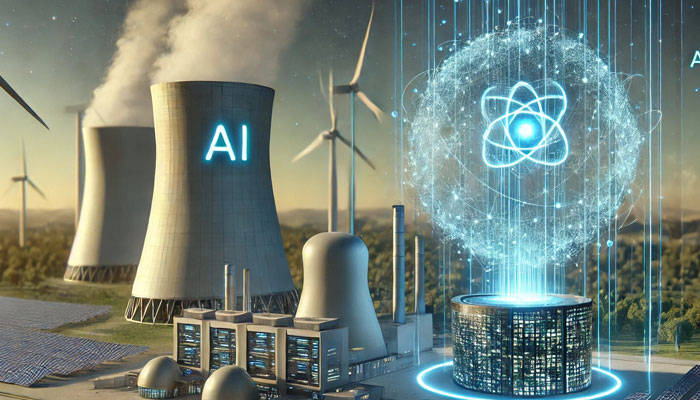
AI and the Energy Foundations of Global Power
By: Samina Mustafa M.Phil Scholar

“The technologies that define eras are rarely confined to their original form; they expand, entangle, and ultimately reshape the very systems that sustain them. What begins as code becomes infrastructure, what appears digital reveals itself as physical, and what seems innovative quietly redraws the map of power itself.”
Artificial intelligence is still commonly described as software—algorithms, models, and abstract computation—but that framing is increasingly inadequate. What we are witnessing is not merely a technological shift, but the construction of a new industrial system. AI operates through vast networks of data centers that consume electricity on a scale comparable to entire cities. In this sense, it resembles less a digital innovation and more a physical infrastructure—akin to power grids, extractive industries, and heavy manufacturing.
This transformation is no longer implicit; it is being openly acknowledged by industry leaders. Executives at companies such as Google have begun to emphasize that the primary bottleneck for AI is no longer computational ingenuity, but energy availability. Their calls for expanding electricity generation across “all sources” signal a deeper reality: the future of AI is inseparable from the politics and economics of energy. Technology firms are now locking in long-term power agreements, exploring private energy generation, and strategically relocating data centres based on proximity to reliable electricity. The scale of investment—hundreds of billions of dollars—resembles national industrial mobilization more than conventional corporate growth.
These developments are already reshaping energy systems. Power shortages, grid congestion, and delays in infrastructure expansion are emerging in regions experiencing rapid data centre growth. In the short term, the urgency of AI demand has also revived reliance on fossil fuels, particularly natural gas, as the most immediate and scalable energy source. While renewable energy and nuclear power are frequently presented as long-term solutions, their deployment timelines lag behind the real-time acceleration of AI infrastructure.
This raises a deeper and more uncomfortable question: is the United States’ pursuit of AI leadership intensifying its long-standing preoccupation with energy security? And if so, does this shift pull it back toward geopolitically sensitive regions such as Iran and Venezuela—states whose strategic relevance has historically been tied to oil and gas reserves?
Individually, American engagement with these regions is not new. However, in the context of AI, the logic appears to be evolving. Data centers require uninterrupted, base load power. This need transforms energy from a background condition into a central strategic variable. If natural gas remains the bridge fuel for AI expansion, then access to reserves, pipelines, and maritime chokepoints regains geopolitical urgency. Energy security, in this sense, becomes intertwined not only with economic stability but with technological supremacy.

The comparison with China further sharpens this dynamic. Over the past decade, China has systematically built an integrated ecosystem around energy and technology. It dominates large segments of solar panel manufacturing, battery production, and critical mineral processing—key components of the clean energy supply chain. This creates a structural advantage: technological ambition supported by domestic production capacity. The United States, by contrast, appears to be pursuing a hybrid strategy—combining renewable expansion, nuclear aspirations, and continued dependence on fossil fuels, particularly natural gas. This approach also aligns with the policy direction under Donald Trump, where expanding domestic fossil fuel production has been framed as essential to meeting rising energy demand.
The emerging “AI race” thus begins to resemble historical contests such as the Cold War space race—not a competition of singular breakthroughs, but of entire systems. Success depends not only on superior models, but on the ability to build, sustain, and scale the infrastructure beneath them. Energy grids, supply chains, and industrial capacity become as decisive as algorithms themselves.
Revisiting Iran and Venezuela through this lens complicates their geopolitical significance. They are no longer merely remnants of a hydrocarbon-dependent world, but potential nodes in a reconfigured energy landscape shaped by AI demand. The question is no longer whether oil still matters—it clearly does—but whether its importance is being reinforced by a new technological paradigm that requires continuous, high-density energy inputs.
For countries like Pakistan, these shifts are far from abstract. Recent analyses by organizations such as Renewables First and the Centre for Research on Energy and Clean Air suggest that Pakistan’s rapid adoption of solar energy has already saved billions in fossil fuel imports over the past several years. What appears to be a response to rising electricity costs may, in fact, represent a strategic repositioning—reducing dependence on volatile global energy markets while building a decentralized energy base.
This opens a different pathway for AI development. If AI is fundamentally infrastructural, then the nature of its energy source becomes a defining factor. Pakistan’s expansion of distributed solar generation offers the possibility of powering future digital systems through locally produced, renewable energy rather than imported fossil fuels. Such a model not only enhances energy security but also insulates technological growth from external shocks.
Yet, these intersections—between AI, energy, and geopolitics—remain underexplored in mainstream discourse. Technology is often discussed in isolation from infrastructure; energy policy is debated without reference to digital transformation; geopolitics is analyzed without integrating either. The result is a fragmented understanding of a deeply interconnected reality.
The critical questions, therefore, are not simply about who leads in AI, but about who controls the systems that sustain it. Who builds the grids? Who secures the fuel? Who owns the supply chains? And perhaps most importantly, who recognizes early enough that in the age of artificial intelligence, power is no longer just computational—it is electrical, material, and profoundly geopolitical.

Comments are closed, but trackbacks and pingbacks are open.