


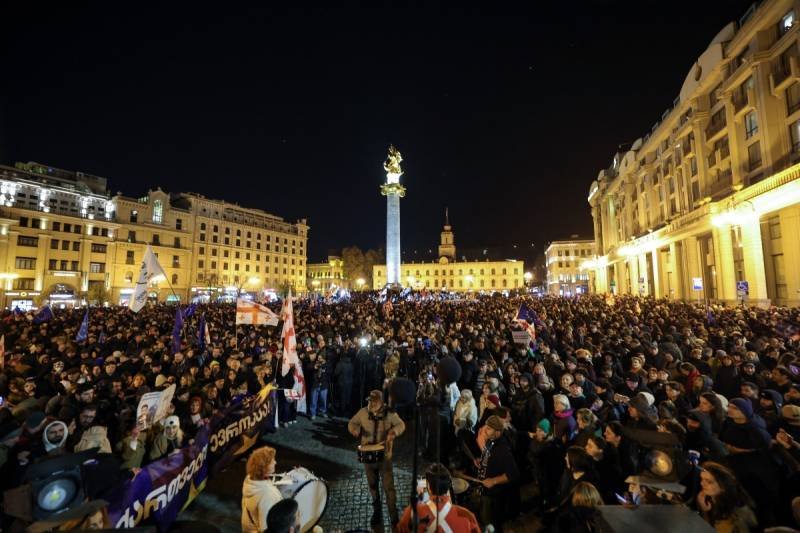
Thousands Rally in Georgia on Second Anniversary of EU Protests
Georgia Opposition Marks Second Anniversary of EU Protests

The Black Sea nation has remained engulfed in political unrest since disputed parliamentary elections in October 2024, when the ruling Georgian Dream party declared victory.
Protests intensified a month later after Prime Minister Irakli Kobakhidze announced that Georgia would put negotiations on joining the European Union on hold until 2028. The decision sparked nationwide demonstrations, which were met with a forceful police response.
Despite mass arrests, heavy fines and increasingly restrictive laws, demonstrators have continued holding daily protests in the capital, Tbilisi, demanding fresh parliamentary elections and the release of detained protesters.
On Saturday, crowds carrying European Union flags and Georgia’s five-cross national flags gathered in Tbilisi’s main square. The rally was organised by five opposition parties that are facing a legal challenge seeking to ban them.
“Let’s show the world that we are not giving up, that we will not submit!” rally organisers said in a statement ahead of the demonstration.
They accused the ruling Georgian Dream party of abandoning Georgia’s European and Euro-Atlantic aspirations, which they said were enshrined in the country’s constitution.
Georgian Dream, which has been in power since 2012, faces criticism from opponents who accuse it of moving the traditionally pro-Western country closer to Russia and weakening democratic institutions. The governing party rejects these allegations.
The government maintains that its policies are intended to defend national sovereignty against foreign interference and attempts by opposition groups to destabilise the country.
Several prominent opposition figures have been imprisoned, while authorities have introduced legislation placing further restrictions on independent media and civil society organisations.
Last month, Georgia’s Constitutional Court began hearing a case filed by the ruling party seeking to outlaw five major opposition groups. The party accuses them of attempting to undermine the country’s constitutional order.
The court has until June 2027 to issue its decision.
The proposed ban has drawn criticism from the European Parliament, which warned that such a move could further distance Georgia from the European Union.
Brussels said this month that although Georgia received EU candidate status in 2023, it remained a candidate “in name only” because of continued democratic backsliding.

Comments are closed, but trackbacks and pingbacks are open.