

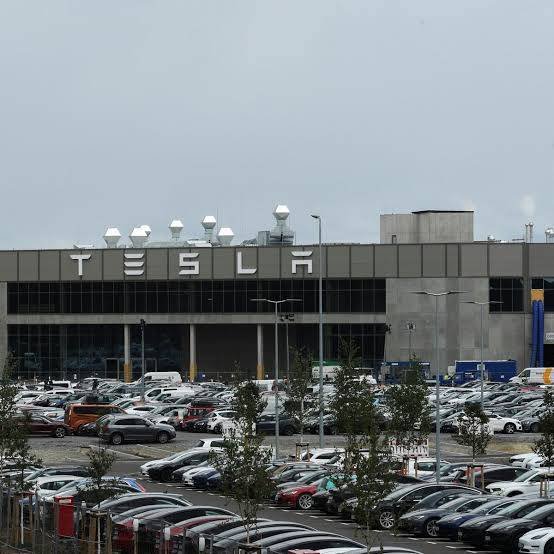
Tesla to Invest 3 bn Euros in Giant German Factory Expansion
The Gruenheide plant will build a new facility to make up to one million driverless Cybercabs each year, despite local protests and Musk’s political storm.

Tesla – (Special Correspondent/Web Desk) – Tesla will invest 3 bn euros ($3.4 billion) to expand its factory near Berlin, the US carmaker announced on Monday. The plan will make Germany a key base for its driverless Cybercab program.
The company said a new facility will be built at its Gruenheide site. In the future, it will be able to make up to one million Cybercabs every year.
The Cybercab is a two-seat car with no steering wheel and no pedals. Tesla first showed it in October 2024. It is already running in some US cities as part of the company’s Robotaxi service.
Construction will start in the first half of 2027. Production is planned to begin in 2029.
Tesla called the project the foundation of its “most advanced” factory in the world. It also said new jobs will be created and that it is already looking for hundreds of workers. The plant now employs about 11,000 people.
The move stands out in Germany’s weak car industry. Volkswagen is cutting tens of thousands of jobs. Mercedes said last week that it would stop all investment in Germany and was considering factory closures.

Chinese competition, high costs and a bumpy switch to electric cars have hurt many German carmakers.
Tesla’s path in Gruenheide has not been smooth. The factory opened in 2022 after a long approval and building process. Residents opposed earlier plans in a poll, worried about cut forests and heavier traffic.
Activists also held protests and camped in treehouses. In March, production stopped briefly after an arson attack on power lines.
Elon Musk is also a divisive figure in Germany because of his support for the far-right AfD party. Tesla sales in the country fell sharply last year.
Still, Brandenburg state leader Dietmar Woidke welcomed the news. He called it a decision of great economic importance and a strong signal that Germany can still attract big industrial investment.
Comments are closed, but trackbacks and pingbacks are open.