
US Weighs MOAB Strike on Iran as Tehran Rejects Surrender
Reports claim Washington is studying the use of its most powerful non-nuclear bomb, raising fears that the war could grow much wider.

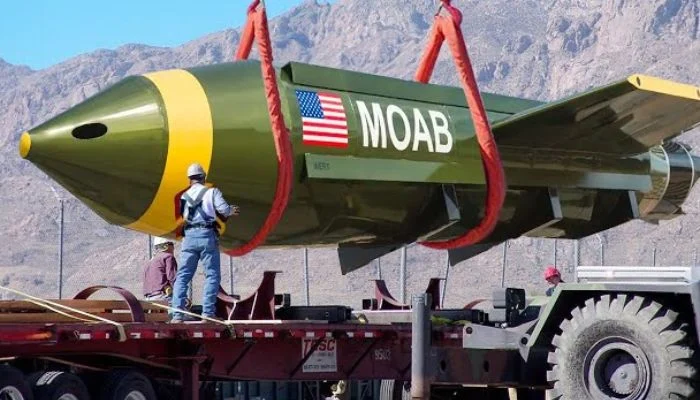
US: The MOAB is back in the news as reports suggest the US military is thinking about using it against Iran. If this happens, the war could enter a far more dangerous stage.
The name stands for Massive Ordnance Air Blast. Many people call it the “Mother of All Bombs.” It is the strongest non-nuclear weapon in the American arsenal.
Its blast power is said to equal about 11 tons of TNT. The destruction zone can reach from roughly 1,000 yards to one mile, depending on the target and the ground.
For readers who are new to this topic, the bomb is huge. It is about 30 feet long and is usually dropped from a large cargo plane. It is built to hit a wide area, not one small spot.
The US has used it only once in real combat. That was in April 2017, when it struck an Islamic State target in Afghanistan. Since then, it has mostly stayed a symbol of raw military power.
Now, talk of using it on Iran has raised alarm. Officials have not publicly confirmed the plan, so the claim should be treated with care. Still, the report shows how heated the conflict has become.
Why does this matter? A weapon this big sends a loud message. Supporters of tough action say it could show strength and push Tehran to the table.
Critics see it very differently. They warn that such a step could anger Iran and its allies, and push the region toward a much larger war.
Iran is a major power in the Middle East. It has partners and groups across several nearby countries. Any big strike could trigger answers on many fronts.
Oil markets also watch these events closely. A wider war near key shipping routes could raise fuel prices around the world. Ordinary families would feel that pain far from the battlefield.
There is also the human side. A blast of this size could harm civilians if it lands near towns or villages. Aid groups often call for caution when such weapons are discussed.
Allies of Washington may feel uneasy too. Some want pressure on Iran but fear a never-ending conflict. Others worry about the risk to their own people and bases.
For now, much is still unclear. It is not known where the bomb might be used, or if it will be used at all. Military plans are often discussed and then changed.
What is clear is that the debate over the MOAB shows how tense the situation is. Leaders in many capitals are now watching for the next move.
Diplomats may still try to cool things down. Talks, even quiet ones, often continue while the guns are loud. Many people hope that path stays open.
Comments are closed, but trackbacks and pingbacks are open.