
Water Crisis Deepens in Havana Amid Power Outages
Prolonged Blackouts Leave Havana Residents Without Running Water

Havana: (News Desk) – Cuban housewife Yuamilka Hechavarria was asleep last Tuesday when water suddenly began flowing into the cistern of the deteriorating building where she lives in Havana’s old city.
She immediately got out of bed and, amid a blackout, rushed to fill a bucket before the tap ran dry. It was the first time water had reached her building in two months.
Her experience reflects a growing crisis across Havana, where prolonged power cuts and deteriorating infrastructure have severely disrupted the water supply for the capital’s nearly two million residents. Many households are now forced to survive without running water for days or even weeks.
Hechavarria, a healthcare worker, said maintaining basic hygiene has become increasingly difficult. For weeks, she had been buying water from street vendors or collecting it from damaged pipes in the neighborhood.
She said diarrhea had spread throughout her building as residents struggled to keep their small homes clean.
“There’s no one in this building who hasn’t gotten sick,” Hechavarria said, adding that she was also recovering from a recent episode of fever and diarrhea.
Health authorities in Cuba have recently warned about the spread of viral infections, including a strain of viral hepatitis, as shortages of electricity and water continue to worsen.
A US health alert issued earlier this month also warned of a significant increase in diarrheal illness across Cuba, linking the situation to the deterioration of the country’s water and energy infrastructure.
Since the United States imposed a fuel blockade in January, power outages in Havana have reportedly become increasingly prolonged, at times lasting more than 24 hours. The electricity shortages have also affected the city’s aging water system, with nearly 90% of its infrastructure dependent on electric-powered pumps, according to Cuba’s National Institute of Hydraulic Resources.
The United Nations Office for the Coordination of Humanitarian Affairs has estimated that around 3.5 million people, or nearly half of Cuba’s population, are experiencing water shortages.
No Escape From a Growing Crisis

Hechavarria lives with her husband and seven-year-old son in a poorly ventilated, single-room home where she struggles to maintain basic cleanliness despite the lack of water and electricity.
A recent power surge damaged her refrigerator, leaving the family without a reliable way to preserve food. She now uses the appliance to store medicines, beans and rice.
With water scarce, she reuses dirty dishwater to clean the floor and flush the toilet. Soap has also become something she uses sparingly because of its cost.
Her husband regularly pushes a homemade handcart carrying two large containers to a pipe outside a nearby school to collect water.
When classes are underway and electricity is available, an electric pump allows water to flow through the pipe into the alley.
However, residents can collect only a small amount when the power supply fails.
Andres Jimenez, a 76-year-old retired metal worker, recently arrived at the collection point just as the electricity went out. By then, only a small trickle of water was coming through.
“If there’s no power, they don’t run the pump,” he said, adding that concerns about hygiene had to be put aside.
Nurse Maria Elena Parlado, who lives in the neighborhood and works at a local clinic, said residents had little choice but to adapt to the worsening conditions.
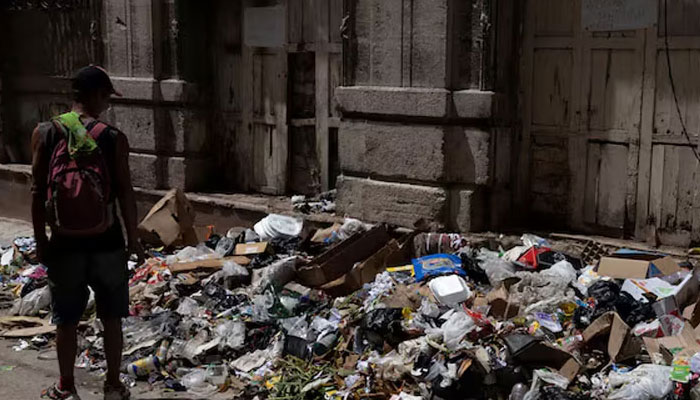
She pointed to a roadside pile of rubbish beside wastewater flowing along the sidewalk as an example of the deteriorating environment.
The clinic where she treats residents suffering from rapidly spreading viral illnesses is also facing water shortages, she said.
“Between one patient and another I should be washing my hands, but sometimes I can’t,” Parlado said.
Comments are closed, but trackbacks and pingbacks are open.