
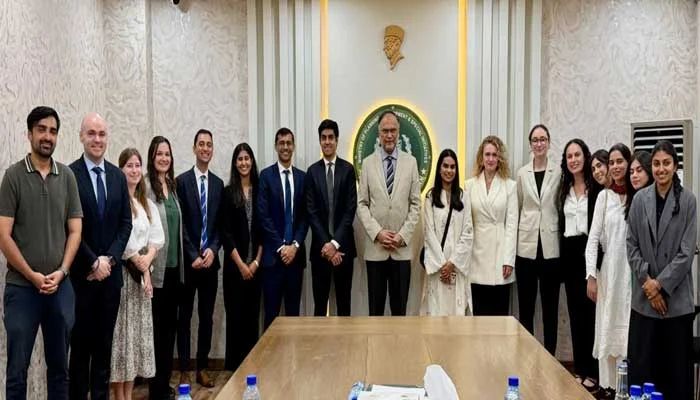

Pakistan – (Staff Reporter/Web Desk) – Federal Minister for Planning, Development and Special Initiatives Ahsan Iqbal has said Pakistan’s biggest task right now is turning its hard-won economic stability into real, lasting growth. He shared this view while speaking to a group of Harvard Business School MBA students who visited the Ministry of Planning and Development on Friday.
Iqbal told the students not to judge Pakistan only by its problems. He asked them to look at the bigger picture instead — a country of nearly 260 million people, most of them young, sitting in a strategic location, rich in farmland and minerals, with a growing digital economy and a diaspora spread across the world.
He said Pakistan keeps falling into the same trap. The economy grows for a while, then runs into trouble with its external accounts, then goes through a painful stabilisation phase, then slows down again. Breaking that cycle, he said, means rebuilding the economy around productivity and exports rather than short-term fixes.
“Stabilisation is necessary, but stabilisation alone is not development,” Iqbal said. He added that austerity alone cannot make a country prosperous. Prosperity, in his words, has to be earned through productivity, new ideas, investment, and exports.
The minister also spoke about URAAN Pakistan, the government’s plan for national transformation. It rests on five pillars, which the government calls the 5Es: exports, enterprise and jobs; the digital economy; climate, food and water security; energy and infrastructure; and fairness and empowerment.
Pakistan has set itself the goal of becoming a trillion-dollar economy by 2035. But Iqbal was careful to point out that hitting a GDP number isn’t really the point. The real question, he said, is what Pakistan will be able to make and sell to the world in 2035 that it simply cannot produce today. That, he said, is what development actually means — building up national capability.
He named productivity, quality, and innovation as the three things that will decide how competitive Pakistan becomes. The government wants to build a national mindset around these three ideas, he said, so that products labelled “Made in Pakistan” start to mean something trustworthy and high-quality around the world.
Iqbal placed a lot of weight on people. He called Pakistan’s population its greatest resource, but also warned that this same young population could turn into a burden rather than a strength if the country fails to invest in education, health, nutrition, and skills. Human capital, he said, is Pakistan’s most important form of infrastructure.
He pointed to artificial intelligence as both a chance and a warning. Countries that don’t build up their own technological skills, he said, risk being left on the losing side of a new global divide in intelligence and technology. He wants Pakistan to become a country that builds and adapts technology in fields like AI, biotechnology, manufacturing, agriculture, and space — not just one that buys and uses it.
On climate change, Iqbal said Pakistan has already learned the hard way that climate risk isn’t a separate issue anymore. It touches the budget, food supply, infrastructure, public health, and poverty all at once.
He also touched on the China-Pakistan Economic Corridor, saying its early years were mostly about building roads, power plants, and infrastructure. The next stage, he said, needs to shift toward industry, technology sharing, agriculture, exports, and direct business partnerships.
Iqbal closed by talking about what successful countries tend to have in common — not necessarily the same economic model, but the same discipline of sticking with a direction over time. He described economic development as compound interest: the steady result of good policies applied consistently, year after year.
Comments are closed, but trackbacks and pingbacks are open.