
Strait of Hormuz, the Petrodollar System, and America’s Strategic Imperative
By: ASIF IQBAL

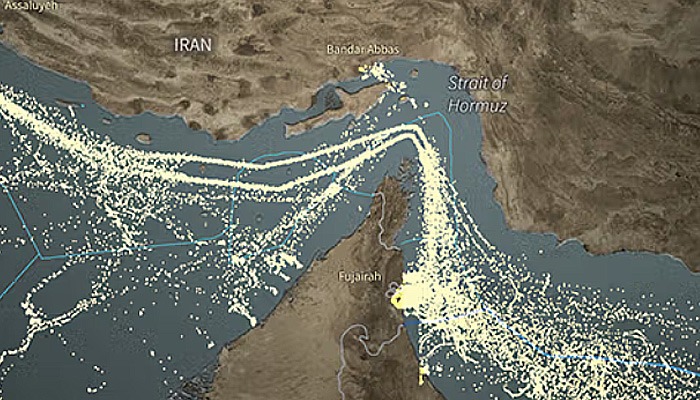
In global politics, certain geographic locations are not merely transit routes but symbols of power, economic control, and strategic dominance. The Strait of Hormuz is one such location where the flow of oil does not just fuel economies but sustains the very foundation of the global financial system. This is precisely why it remains critically important for the United States, particularly for leaders like Donald Trump.
To fully understand this issue, one must go back nearly fifty years to the creation of what is known as the petrodollar system. In the 1970s, after the United States abandoned the gold standard under Richard Nixon, it needed a new mechanism to preserve the global dominance of the U.S. dollar. This led to a historic arrangement with Saudi Arabia, under which global oil trade would be conducted exclusively in dollars. In return, the United States provided security guarantees, and surplus oil revenues were reinvested into U.S. financial markets, particularly in Treasury bonds.
This system proved to be a “cash cow” for the United States. The world needed oil, and oil required dollars. As a result, global demand for the dollar remained consistently strong. However, the system’s strength also became its greatest vulnerability: it was deeply dependent on the political stability of the Middle East.
Now, in 2026, the United States is burdened with nearly $40 trillion in debt. To sustain and refinance this massive liability, it requires a continuous inflow of capital Much of which historically came through the petrodollar cycle. But today, that system is under increasing strain, and one of the central reasons is the growing uncertainty surrounding the Strait of Hormuz.
At first glance, rising oil prices during a crisis might seem beneficial for the U.S. economy. However, the reality is far more complex. If oil shipments are disrupted, then despite higher prices, actual revenues decline. Oil-exporting nations may earn more per barrel, but without consistent delivery, the overall cash flow is interrupted. As a result, the surplus funds that once flowed into U.S. Treasury markets begin to shrink.
On the other side, oil-importing countries such as India face a different kind of pressure. As oil prices rise, their import bills increase significantly, forcing them to secure more dollars. One of the easiest ways to do this is by selling their existing holdings of U.S. debt. This creates a dual pressure on the American economy: increased demand for dollars globally, while at the same time, U.S. bonds are being sold off.
This results in a dangerous double impact for the United States reduced inflows of new capital and simultaneous outflows of existing investments.
At the same time, a broader geopolitical shift is taking place. Countries in the Middle East are beginning to realize that decades of “security payments” to the United States have not guaranteed their long-term stability. As a result, they are exploring alternative strategies strengthening ties with emerging powers like China and even considering conducting oil trade in non-dollar currencies.
The petrodollar system has survived multiple global crises, but the potential disruption or closure of the Strait of Hormuz presents a uniquely serious threat. This is because the system itself is fundamentally centered around the Middle East. When the political landscape of the region begins to shift, the financial structures built upon it inevitably start to change as well.
For leaders like Donald Trump, this situation is not just a matter of foreign policy it represents an economic battlefield. Keeping the Strait of Hormuz open is no longer simply about ensuring the flow of energy; it is about maintaining the global dominance of the dollar, stabilizing U.S. debt markets, and preserving America’s economic supremacy.
The emerging reality suggests that if the political order of the Middle East is reshaped, the global financial system will be reshaped alongside it. The world may be approaching a turning point one where the long-standing dominance of the U.S. dollar faces its most serious Challenge in modern history.
Comments are closed, but trackbacks and pingbacks are open.