
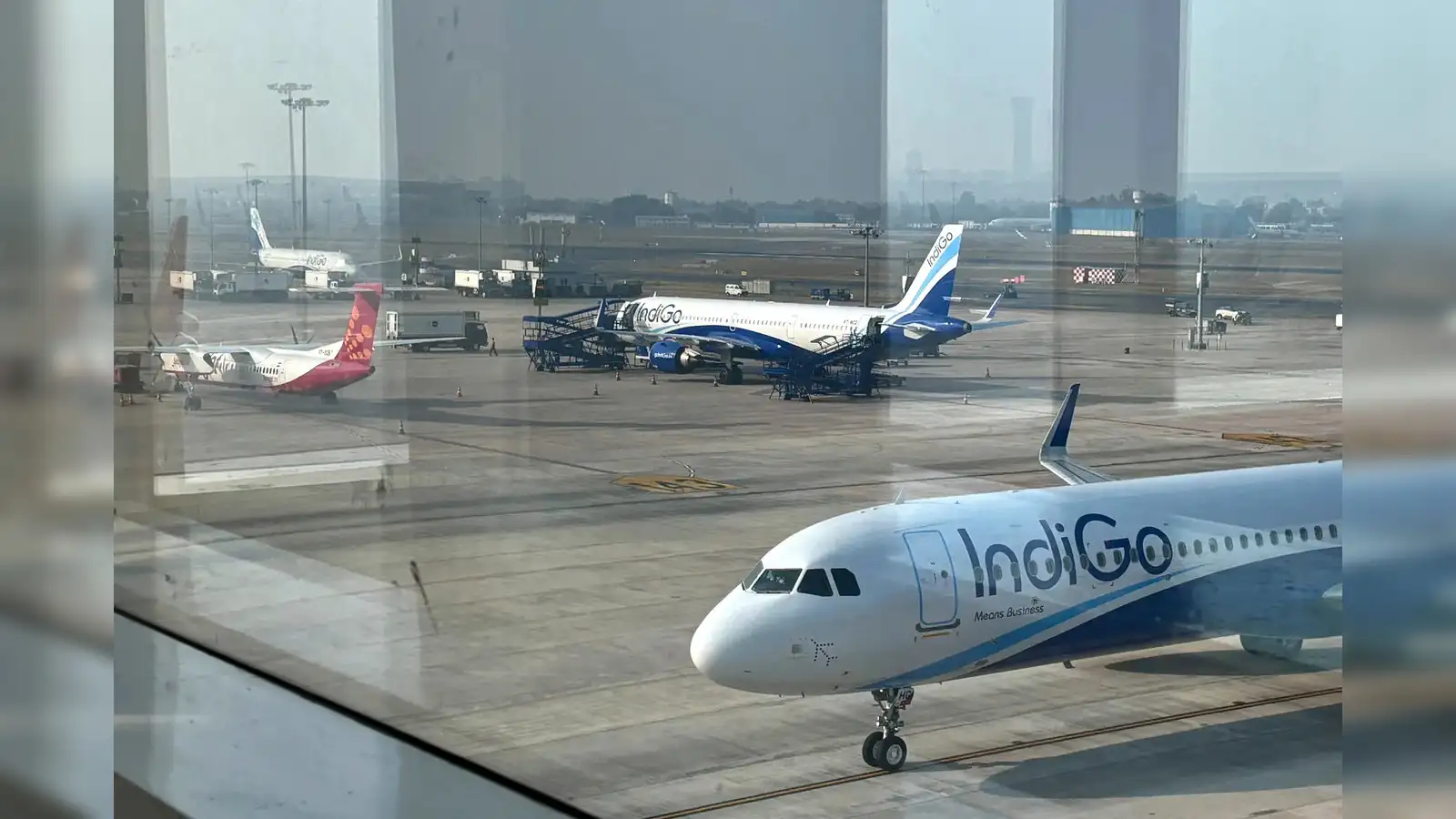
Iran War Deals Double Blow to Indian Airlines Amid Airspace Ban
Middle East conflict and Pakistan airspace ban force Indian airlines to cancel flights, take longer routes, and face rising costs.

Indian Airlines – (Web Desk) – The war in the Middle East has created new problems for Indian airlines. Many countries in the region have limited the use of their airspace. This region is very important for flights from India to Europe and the United States. Indian airlines already face trouble because Pakistan stopped them from using its airspace last year.
Now airlines have very few route options. Flights have to change their schedules or take longer paths. This has increased pressure on airline operations.
Data from Cirium shows that the two largest international airlines in India, Air India and IndiGo, could not operate 64 percent of their 1,230 scheduled flights to the Middle East, Europe, and North America during the last ten days.
Aviation expert Amit Mittal said this situation has created two major challenges for Indian airlines that operate international flights.
Pakistan closed its airspace to Indian airlines in April last year after military tensions between the two countries increased.
Financial experts are also worried about the impact. HSBC recently said the tensions in the Middle East could raise costs and reduce profits for Indian airlines. The bank estimates that if flights remain cancelled for seven days, airlines could lose about 1.2 percent of their expected yearly profit before tax.
Some flights have started again in the past few days, but IndiGo is facing special difficulties. The airline depends on six long-range Boeing aircraft that it has leased from Norse Atlantic Airways to fly to Europe.
These planes are still registered in Norway. Because of this, they must follow safety advice from the European Union Aviation Safety Agency. The agency has asked airlines to avoid the airspace of Iran, Iraq, Israel, Kuwait, Lebanon, Qatar, the United Arab Emirates, and Saudi Arabia.
As a result, IndiGo must take longer routes over Africa. In some cases, flight times have increased by almost two hours.
Even these routes have problems. On Sunday, an IndiGo flight from Delhi to Manchester had to return to Delhi. Air traffic officials in Eritrea did not allow the plane to use their airspace because of confusion about the Norwegian-registered aircraft.
IndiGo said the plane turned back after 13 hours in the air because of last-minute airspace restrictions.
Another IndiGo flight from London to Mumbai faced a similar problem on Monday. It could not enter Eritrean airspace and had to land in Cairo instead.
Flight disruptions due to the Middle East conflict add to problems at IndiGo whose CEO Pieter Elbers stepped down on Tuesday, in the aftermath of an operational crisis that drew scrutiny from the public and the government in December.
IndiGo and Air India did not respond to Reuters queries. Norse referred Reuters’ questions to IndiGo.
Air India said on Monday that it would operate 78 additional flights on routes between India and Europe and the US over the next week in response to high demand during the Iran conflict.
But its flight times to some destinations are becoming much longer as it is forced to add a stopover, giving an edge to rivals like Lufthansa and American Airlines on routes to and from India.
Air India’s Delhi to New York flight on Monday made a stopover in Rome, extending the journey time to nearly 22 hours, according to Flightradar24. Before the Iran war, Air India could fly via Iraq and Turkey and reach the US in about 17 hours with no stops.
Airlines Raise Ticket Fares As Jet Fuel Prices Surge Pakistan
In comparison, an American Airlines flight on Sunday took about 16 hours on the same route, via Pakistan.
Air India, owned by Tata Group and Singapore Airlines has forecast a hit of $600 million a year due to the Pakistan airspace ban, Reuters has reported. The airline, which was sold by the Indian government in 2022, has been reporting losses which amounted to $433 million last year.
Longer flight times will only add to the airline’s costs as they mean more fuel usage, further pushing up energy costs on top of the spike in oil prices since the US-Israeli war with Iran began.
Comments are closed, but trackbacks and pingbacks are open.