
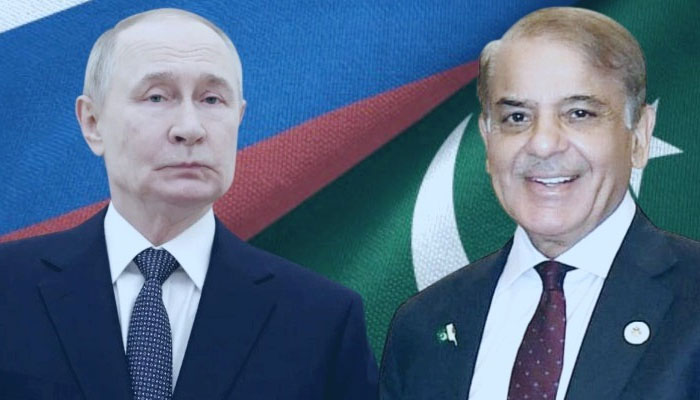
Prime Minister Shahbaz Sharif’s visit to Russia represents a strategic diplomatic balancing act for Pakistan
(By: Asghar Ali Mubarak)

Prime Minister Shahbaz Sharif’s visit to Russia represents a strategic diplomatic balancing act for Pakistan.
Pakistan-Russia relations have entered a new and stable era in 2026, centered on economic partnership, energy projects, and regional security. Russia has also offered to mediate to reduce the recent Pak-Afghan tensions. Progress with Russia is part of Pakistan’s strategy of diplomatic balance. In such a situation, the official visit of Pakistani Prime Minister Shahbaz Sharif to Russia is not just a diplomatic engagement but an expression of Pakistan’s practical strategy in the changing global scenario. The two countries are closely cooperating in the fight against terrorism, especially against ISIS, and on the situation in Afghanistan. During the visit to Russia, Prime Minister Shahbaz Sharif will have his fifth meeting with President Putin. A major business forum is being organized on the occasion of this visit, in which more than 100 Pakistani companies will participate. The first Pak-Russia Media Forum was held in Moscow in February 2026 with the aim of strengthening ties at a public level. Russia has informed Pakistan that its LNG terminals will be operational by 2026, which will increase gas flows between the two countries. The trade will be paved. In January 2026, the two countries reached an important consensus on the revival and expansion of Pakistan Steel Mills. Russia is in talks to upgrade Pakistan’s oil refineries and increase crude oil supplies to 10 million tons. Practical steps have been agreed to start direct air links between Moscow and Islamabad. Pakistan is interested in becoming part of this strategic corridor of Russia to gain access to Central Asia and Russia. Pakistan sees these relations as a “Eurasian partnership” in its foreign policy, which aims to broaden the economic base beyond traditional allies. Pakistan’s foreign policy is no longer one-sided. Efforts are being made to advance relations with China, the US, and Russia in a balanced manner. Relations with the US are multifaceted and sensitive. The changes in global politics after the ongoing military operation in Ukraine have raised new questions of energy, trade, and diplomatic balance. In such an environment, the growing contact between Islamabad and Moscow has assumed extraordinary importance. It is not easy to reach the Kremlin corridors in Moscow, and the meeting with Russian President Vladimir Putin will be much more than a formal discussion. In its background, there are practical issues such as bilateral interests, energy needs, financial arrangements, and regional stability. Pakistan needs cheap energy and a stable supply line, while Russia is looking for new markets and partners. The history of Pakistan-Russia relations has not been limited to diplomatic statements. The Pakistan Steel Mills, established with Soviet cooperation in the 1970s, was a prominent symbol of industrial cooperation between the two countries. This project was proof that Pakistan-Russia relations can also be built on practical foundations. There is also a possibility that progress can be made on a memorandum of understanding or a new framework of cooperation regarding Pakistan Steel Mills. If this happens, it will not only be a renewal of a historical chapter but also the beginning of a new era of industrial revival and bilateral economic partnership. However, the real importance will be that the potential agreement can go beyond paper declarations and be transformed into practical measures. Diplomatic relations between Russia and Pakistan were established in May 1948, when Pakistan established diplomatic relations with the Soviet Union. These relations have gone through various stages over time, including tensions during the Cold War and later economic and defense cooperation. Nowadays, relations between the two countries have improved significantly, and cooperation in various fields is increasing. After the collapse of the Soviet Union, relations between Russia and Pakistan improved significantly. In the 1990s, the two countries restructured their relations and promoted cooperation in the economic and trade sectors. In the 2000s, defense cooperation between the two countries also increased, which included arms sales by Russia to Pakistan. Recently, relations between Russia and Pakistan have improved further. The two countries have also promoted cooperation in the energy sector, which includes the North-South gas pipeline project. In addition, joint military exercises have been held between the two countries, which is evidence of their growing defense cooperation. Economic relations between Russia and Pakistan have also improved. The two countries have signed various trade agreements, which aim to increase mutual trade. In terms of cultural relations, the two countries have also promoted educational and cultural exchanges, which have further strengthened public-to-public relations. There are also some challenges in Russia-Pakistan relations, including regional politics and emerging issues at the global level. However, both countries have tried to face these challenges through diplomatic negotiations and have taken various steps to strengthen their relations.In this context, the Pak-Russia gas pipeline project is also worth mentioning, which can become another example of long-standing cooperation in the energy sector. If there is solid progress in both these projects, the current visit can become the basis for not just a diplomatic activity but a practical economic partnership. The role of Pakistan’s Ambassador to Moscow, Faisal Niaz Tirmizi, is also prominent in the diplomatic preparations for this visit. The schedule of high-level meetings, the involvement of business representatives, and the dynamic diplomacy of the embassy in setting the bilateral agenda are part of the effort to align this visit with practical results. An important aspect of the visit is also the Pakistan-Russia Business Forum, in which 90 companies from Pakistan are participating, which will provide a platform for direct engagement with the private sector, along with government negotiations. This forum is expected to discuss the possibilities of cooperation in the energy, agriculture, pharmaceuticals, IT, and textile sectors. If a workable framework is provided to the business community, this forum can become the basis for a real increase in bilateral trade, not just a showpiece activity. The fact is that bilateral trade between Pakistan and Russia is still below its true potential, and the Business Forum is an attempt to fill this gap so that government-level agreements can be translated into private investment and practical projects. An important but less discussed aspect is the readmission agreement between Pakistan and Russia, which has not yet been finalized. The completion of this agreement could prove to be a significant breakthrough in legal and immigration cooperation and strengthen confidence-building between the two countries. Similarly, visa policy is a major practical issue. The obstacles faced by Pakistani businessmen in Russia in issuing business visas and the strictness of student visas are affecting the pace of trade and educational ties. If the goals of the business forum are to be implemented, visa facilitation will have to be prioritized.
The Prime Minister’s meeting with Pakistani students residing in Moscow and the iftar also have an aspect of soft diplomacy. Pakistani youth studying in Russian universities can prove to be future diplomatic and trade bridges, provided that facilitation is ensured at the policy level. This visit is certainly full of possibilities, but the real test will be in implementing the agreements. Energy, trade, business forum, readmission agreement, and visa policy are the points that will determine the real direction of Pak-Russia relations. These meetings in the cold atmosphere of Moscow can determine the future direction. If practical progress is made in the energy, industry, and trade sectors, this visit can prove to be historic and can give a new dimension to Pak-Russia relations.
Diplomatic activities in Russia have intensified ahead of the expected visit of Pakistani Prime Minister Mian Muhammad Shahbaz Sharif to Moscow. Official spokesperson of the Russian Foreign Ministry, Maria Zakharova, has said that a Russian-Pakistani media forum is being held in Moscow, which has been organized against the backdrop of the scheduled visit of the Prime Minister of Pakistan. This forum has been organized on the platform of the International Multimedia Press Center “Russia Today”, in which Russian and Pakistani journalists, diplomats, political experts, and analysts are participating. During the forum, fundamental changes underway in the system of international relations, modern trends in global journalism, and practical cooperation between media institutions of the two countries will be discussed. Its main objective is to provide the people of Russia and Pakistan with direct and authentic information about each other. It was said that this is not just a local event but will also be broadcast live via telebridge between Moscow and Islamabad, which will be broadcast on Russian and Pakistani media platforms. The holding of the media forum is a clear indication that activities regarding Pak-Russia relations in Moscow are entering a practical phase. The Islamabad media forum discussed in detail the rapidly developing relations between Pakistan and Russia, regional security, and information cooperation. Addressing the media forum, Pakistan’s Ambassador to Russia, Faisal Niaz Tirmizi, said that relations between Pakistan and Russia are moving towards positive progress and both countries are keen to further expand cooperation in various fields. In recent years, there has been a significant increase in political, economic, defense, educational, and people-to-people contacts.The numerous meetings between Prime Minister Shehbaz Sharif and Russian President Vladimir Putin reflect the continuity of high-level diplomatic relations, while the upcoming meeting will be the fifth major summit between the two countries. The Pakistani ambassador announced that a Pakistan-Russia Business Forum will be held on the occasion of the Prime Minister’s visit, in which more than 100 Pakistani companies will meet with their Russian counterparts to ensure practical progress in the trade, investment, and energy sectors. Mentioning cooperation in the field of natural disasters, he said that Russia provided timely humanitarian assistance to Pakistan after the 2005 earthquake and the 2022 floods. In November 2025, a delegation of Russian emergency services visited Islamabad, while recently a high-level delegation from the Russian Foreign Ministry met with relevant institutions, including the National Disaster Management Authority (NDMA). The two countries agreed to enhance cooperation in the field of natural disaster prediction, prevention, and recovery. The Pakistani ambassador further said that Russia considers Pakistan as an important partner of the wider Eurasian region in South Asia, and regional cooperation has become indispensable in the multipolar world system. In addition, Russian Foreign Ministry Spokesperson Maria Zakharova, while addressing the Moscow-Islamabad Media Forum, said that this forum plays an important role in promoting bilateral relations because not only political leaders and diplomats but also journalists participate here, which is essential for strengthening informational and cultural ties. Maria Zakharova said that in today’s global scenario, information has become a new global power, and new dimensions of influence and protection of national interests have emerged in the world through the media. With access to accurate information and transparent exchange of views, we can establish a strong and balanced global system, where different cultures and civilizations can develop with their unique roles. He further said that in the present era, misuse of information or propaganda, through modern technology and digital resources, can affect the political and social stability of nations, which is why media forums such as the Moscow and Islamabad forums are very important because they provide a constructive and mutually informative dialogue that promotes trust and cooperation in international relations. Strengthening relations between Russia and Pakistan in the media, education, culture, and information sectors not only promotes bilateral ties but also contributes to the establishment of a stable, balanced, and diverse global order at the global level. Russian Ambassador to Pakistan Albert Khorev, while addressing the forum, said that this media forum and other joint activities provide an opportunity for experts from both countries to better understand each other’s ideologies and national interests and set the path for further development of bilateral relations. He said that in today’s global scenario, a unipolar world system has ended and a multi-centric system is strengthening in global relations. The importance of the southern countries is increasing, but at the same time, new challenges, conflicts in the region, illegal unilateral sanctions, and growing threats of extremism are also emerging. The ambassador stressed that cooperation between Pakistan and Russia is important in such a situation so that regional stability, economic ties, and mutual interests in the humanitarian sectors can be further promoted. Geopolitical expert Roksolana Zygon said that the recent cooperation between Moscow and Islamabad is the result of a strong combination of public diplomacy and traditional diplomacy. Although relations fluctuated during the Cold War, the change in the balance of global power and regional circumstances brought the two countries closer to common strategic goals. Referring to the situation in Afghanistan, she said that the changes that took place in the early 2010s provided an opportunity for Russia and Pakistan to restore relations, after which cooperation in various fields accelerated. Roksolana Zygon said that Pakistan often had to stand alone in the war against terrorism, and negative narratives about Pakistan were also seen in the international media, which did not correspond to the ground realities. The media forum was also addressed by Senator Mushahid Hussain Syed, Director General of the Institute of Strategic Studies, Islamabad, Aizaz Ahmed Chaudhry, and other prominent speakers. The forum was jointly organized by the Rossiya Sivodnaya Media Group, the Ministry of Information and Broadcasting of Pakistan, the Associated Press of Pakistan, and other institutions. At the end of the event, it was reiterated that Pakistan and Russia would further strengthen their relations on the basis of mutual respect, common interests, and regional stability.It may be recalled that recently, the Institute of Strategic Studies Islamabad, through its Center for Strategic Perspectives, launched its newly revised book Pakistan-Russia Relations: A Comprehensive Historical and Strategic Analysis. Ambassador Sohail Mahmood, in his introductory remarks, said that Pakistan-Russia relations have undergone a significant evolution over the past 75 years, moving away from the Cold War and towards increasing synergy in diplomatic, economic, and strategic spheres. He recalled that despite initial geopolitical obstacles, relations never completely broke down, as evidenced by Pakistan’s industrialization, energy projects, and mediation efforts such as the Tashkent Declaration. High-level exchanges maintain diplomatic ties and cooperation in areas such as counter-terrorism, defense dialogue, energy, agriculture, and parliamentary contacts mark a new era of mutual understanding. Pakistan recognizes Russia’s important role and place in the changing international system and considers this relationship as part of a broader commitment to balanced relations with all major powers. Ambassador Sohail Mahmood paid tribute to the contributing authors and described the book as a valuable contribution to the partnership that continues for the mutual benefit of both countries. Dr. Vyacheslav Belokrantsky, Head of the Department of Middle East Studies at the Institute of Oriental Studies, Russian Academy of Sciences, said that Russian institutions are conducting extensive research on Pakistan’s growing relevance in Russia’s foreign policy and expressed confidence that sustainable academic cooperation will promote mutual understanding. The former Pakistani ambassador to Russia drew on his diplomatic experience in Moscow during both the Soviet and modern Russian periods. He observed that contemporary relations depend on mutual respect, goodwill, and expanding cooperation in multilateral forums such as defense, energy, diplomacy, and the Shanghai Cooperation Organization. Highlighting key milestones, including the 2014 defense cooperation agreement and the Pakistan Stream gas pipeline, he said that academic and institutional ties are growing, noting that bilateral trade had reached US$1 billion before the banking and sanctions-related hurdles, and he endorsed the expansion of defense cooperation, convergence on Afghanistan, and cultural interest between the two societies. Ambassador Albert P. Khorev said that despite global challenges and ‘illegal Western sanctions’, cooperation between Pakistan and Russia has expanded in the areas of energy, trade, counter-terrorism, security coordination, humanitarian exchanges, and parliamentary diplomacy. He appreciated Pakistan’s ‘balanced and friendly neutrality’ on key global issues, including the Ukraine conflict, despite pressure from external powers. The ambassador outlined concrete areas of progress. He also highlighted the development of Russian language centers in Pakistan and the deepening academic and cultural ties. He stressed that Russia sees Pakistan as a key regional actor at the crossroads of South, Central, and West Asia, central to connectivity initiatives, trade corridors, and energy projects in line with President Putin’s vision of ‘Greater Eurasian Partnership’. Ambassador Khorev reiterated Russia’s readiness to support regional stability.
Comments are closed, but trackbacks and pingbacks are open.