

CJP reviews nationwide reforms in judicial infrastructure efficiency
Chief Justice reviews nationwide judicial reforms, emphasizing solar energy, e-libraries, women facilities, and modern court infrastructure improvements.

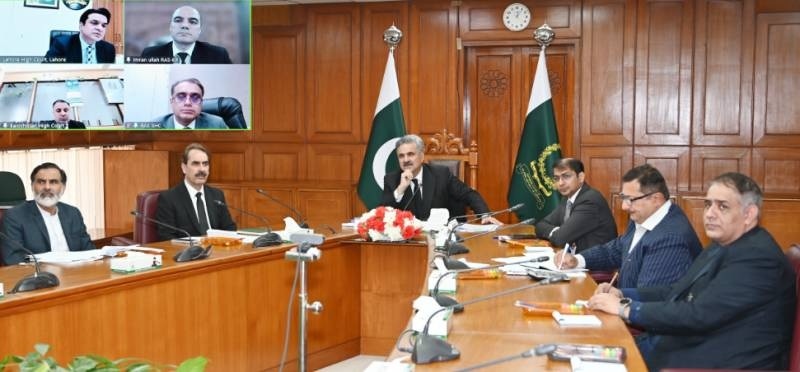
Lahor LJCP – (Web Desk) – The Chief Justice of Pakistan, who also serves as Chairman of the Law and Justice Commission of Pakistan (LJCP), recently chaired a meeting to review progress on nationwide judicial infrastructure reforms, with a special focus on solarizing courtrooms and bar rooms across the country.
The meeting brought together the Secretary of the LJCP and Resident Additional Secretaries from all provinces. Participants reviewed ongoing projects under the Judicial Development Fund (JDF), the Under-Developed Regions (UDR) window of the Access to Justice Development Fund (AJDF), and other federal and provincial grants. They carefully assessed progress, funding, implementation gaps, system capabilities, and technical setups.
In Punjab, a major infrastructure package has been approved, including Rs 99.575 million under UDR, Rs 1,042.893 million under JDF, and Rs 490.442 million in grant-in-aid. Solar panels have already been installed in 56 bar rooms, while work continues in 47 more. The provincial government is also prioritizing solarization for district court complexes, including those in District Kasur and Tehsil Fort Abbas (Bahawalnagar), for the 2025–26 fiscal year.
Officials have pledged to ensure uninterrupted power supply to courts by August 31, 2026, using solar energy where the main grid cannot reliably provide electricity.
Complementary reforms include establishment of e-libraries, installation of water filtration plants, daycare centres, women facilitation facilities, visitation rooms, common rooms, and separate washrooms for women.

In Sindh, reforms under UDR, JDF, and grant-in-aid allocations cover solarization of courts and bar rooms, establishment of e-libraries and e-kiosks, installation of water filtration plants and R.O./U.F. systems, development of women-centric facilities, and air-conditioning in heat-intensive areas. Solarization projects cover 65 bar rooms and 92 courts at district and taluka levels, while e-libraries are being established in dozens of bar rooms and courts. Women-centric facilities are under development in multiple districts and talukas, with several sites already completed.
Khyber Pakhtunkhwa has received allocations of Rs 24.8 million under UDR, Rs 247 million under JDF, and Rs 277 million as grant-in-aid. Solarization has been completed in 51 bar rooms and 39 courts, while e-libraries have been established in 66 bar rooms and 62 courts. Water filtration plants have been installed in 22 districts and 11 tehsils. The province has also undertaken construction of new family courtrooms in Peshawar and Takht Bai, Mardan. An additional Rs 298 million has been released to ensure universal provision of hybrid solar systems, fully equipped e-libraries, and water filtration facilities. A women-centric initiative titled “Da Sar Soury” is being piloted in Swabi and Haripur to provide integrated legal aid and support services.
In Balochistan, allocations include Rs 10.31 million under UDR, Rs 64.01 million under JDF, and Rs 172.16 million as grant-in-aid. Solarization has been initiated in all 35 Sessions Divisions, covering 52 buildings, with most divisions already completed and the remainder expected by June 30, 2026.
Maryam Nawaz launches Pakistan’s first e-taxi scheme nationwide
E-libraries have been established in all Sessions Divisions, and water filtration plants installed in several divisions. Tenders have also been issued for establishment of e-courts in each Sessions Division.
All provincial projects are supervised by the Secretary, Law and Justice Commission of Pakistan, and personally monitored by the Chief Justice of Pakistan, with Resident Additional Secretaries ensuring oversight, coordination, and adherence to timelines.
Comments are closed, but trackbacks and pingbacks are open.