
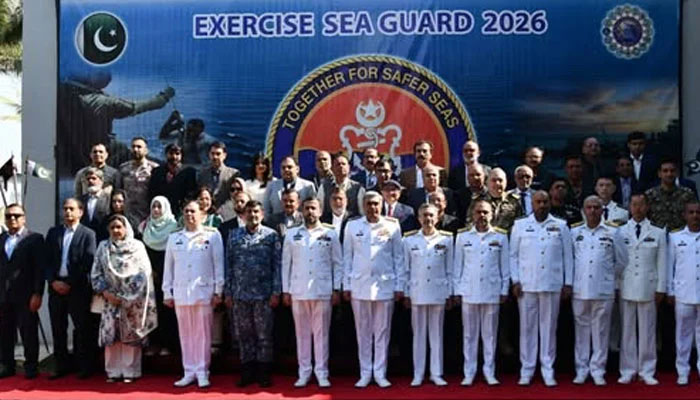

Pakistan Navy is conducting a national-level Exercise SEA GUARD 2026, in collaboration with key national stakeholders, from 2 to 9 February 2026 across the country’s vital maritime zones, including Karachi, Ormara, Gwadar and adjoining coastal areas and at sea. The exercise is another significant milestone in Pakistan Navy’s continuous efforts to enhance maritime security, inter-agency coordination and preparedness against both traditional and non-traditional threats in the maritime domain.
Exercise SEA GUARD 2026 has been designed to evaluate and strengthen the cohesive capability of concerned organizations to safeguard Pakistan’s maritime interests through a collaborative approach, bringing civil and military stakeholders together. All practical scenarios during the exercise are being centrally coordinated from the Joint Maritime Information and Coordination Centre (JMICC) of Pakistan Navy, located at Manora, Karachi.
Exercise SEA GUARD 2026 is being conducted as a national-level maritime exercise, integrating a wide range of stakeholders responsible for maritime law enforcement, port security, disaster response, environmental protection and intelligence sharing. Alongside Pakistan Navy, the exercise is witnessing active participation from Pakistan Maritime Security Agency (PMSA), Pakistan Coast Guards, port authorities, law enforcement agencies, intelligence organizations and civil sector entities.
The exercise aims to evaluate and refine inter-agency coordination mechanisms, particularly the timely sharing of maritime information and synchronized responses to emerging situations at sea. Scenarios have been crafted to mirror real-world challenges faced in Pakistan’s maritime environment, ensuring that lessons learned remain directly applicable to operational realities. The central theme of Exercise SEA GUARD 2026 is maritime security, with emphasis being placed on countering threats such as illegal activities at sea, piracy, smuggling and potential terrorist threats against maritime infrastructure. Given Pakistan’s reliance on secure Sea Lines of Communication (SLOCs) for trade and energy supplies, the exercise highlights the importance of constant vigilance and proactive maritime domain awareness.
Recognizing the humanitarian dimension of maritime operations, Exercise SEA GUARD 2026 has included extensive Search and Rescue (SAR) scenarios. These involve simulated distress situations at sea, requiring rapid coordination among naval units, maritime law enforcement agencies and civil authorities. Such drills reinforce Pakistan’s commitment to fulfilling its international obligations for the safety of life at sea. The ability to respond effectively to maritime accidents, fishing vessel emergencies or passenger craft in distress remains a vital component of national maritime responsibility.
Another key component of the exercise is the impartial evaluation by an independent authority. This provides an opportunity for neutral analysis of the exercise conduct. The exercise is validating procedures for collecting, analyzing and disseminating maritime information among stakeholders, thereby enhancing situational awareness across the maritime domain. Effective information sharing is being tested under time-sensitive conditions, highlighting the importance of integrated systems and robust communication channels.
The selection of exercise area highlights its strategic and economic importance to Pakistan. Karachi remains the country’s primary commercial port, while Gwadar represents a key node in regional connectivity and economic development. By conducting Exercise SEA GUARD 2026 across these critical maritime zones, Pakistan Navy and partner agencies are reinforcing their commitment to ensuring security and the uninterrupted functioning of national ports and coastal infrastructure.
Comments are closed, but trackbacks and pingbacks are open.