
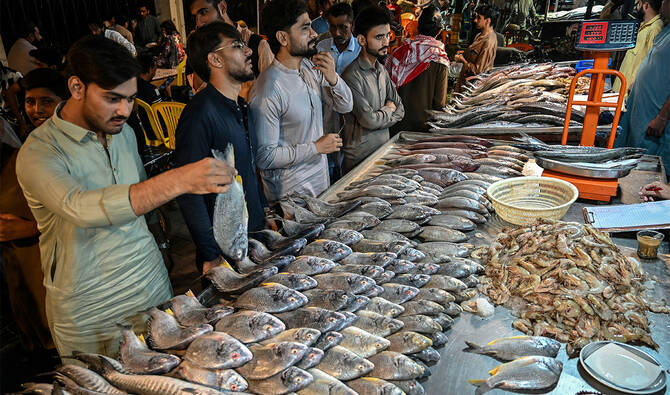
Karachi Cold Snap Boosts Arabian Sea Seafood Demand
Winter chill in Karachi sparks soaring seafood demand, pushing prices higher and keeping fishermen busy in Arabian Sea waters.

Karachi – (Special Correspondent / Web Desk) – As winter temperatures plunge unusually low in Karachi, the southern port city of Pakistan, seafood demand has surged, pushing prices higher in markets and restaurants. Fishermen are venturing further into the Arabian Sea in search of prized seasonal catches.
Karachi, usually known for its mild winters, has recently seen temperatures drop to 8.1°C. This cold snap has drawn crowds to the city’s famous Keamari Seafood Street, where diners flock to enjoy barbecued fish, fries, and spicy karahi dishes in open-air eateries.
Industry experts note that the chill has triggered a seasonal jump in seafood consumption, with demand rising by up to 90 percent—especially for larger winter fish that are also popular in export markets.
At sea, fishermen notice that winter changes both the types of fish caught and their earnings. “During this season, we chase bigger fish like ribbonfish, king mackerel, and pomfret, with ribbonfish being the most common,” said Adam, a 70-year-old fisherman from Ibrahim Hyderi harbor. “In summer, we mostly catch prawns and small shrimp near Karachi and Gwadar.”
He added, “Squid and other large winter fish are in high demand. They sell well and bring good prices.”
Adam is one of more than 100,000 registered fishermen under Pakistan’s Fishermen’s Cooperative Society (FCS), many of whom brave foggy winter seas to supply both local markets and export processors.
Pakistan’s marine fisheries sector contributes roughly one percent of GDP and earned $253.2 million in exports during July–December FY26, a 22 percent increase from a year earlier, according to the ministry of maritime affairs.
The export growth comes as Pakistan, grappling with external financing pressures, seeks to boost foreign exchange earnings.
“This season our seafood exports have crossed $250 million, and will hit the $600 million target for this year,” said Irfan Ahmed, in-charge at Ibrahim Hyderi harbor for the FCS.
Pakistan exports frozen fish, sardines, king mackerel, squid, ribbonfish, pomfret, flatfish species, shrimps, prawns, cuttlefish, fish meal and crabs, with China, Saudi Arabia, the United Arab Emirates, Thailand, Malaysia, Japan, the European Union, Vietnam, Kuwait and the United States among its major buyers.
“The demand for seafood shoots up [in winters] and therefore we at Fishermen’s Cooperative Society’s fisheries department facilitate the launches at our harbor to go and fish as much as possible,” Ahmed said.
At retail markets, the seasonal rush has translated into steep price increases.
“In this winter season, our demand has increased about 90 percent,” said Azam Khan, a fish retailer at Keamari Seafood Street.
The surge has pushed prices sharply higher, he said.
Seabream now sells for Rs1,200 ($4.30) per kilogram, up from Rs700 ($2.50) in summer.
King mackerel has risen 50 percent to Rs1,650 ($5.90) from Rs1,100 ($3.90).
White pomfret has doubled to Rs3,000 ($10.70) from Rs1,500 ($5.40), while red snapper has climbed 120 percent to Rs2,200 ($7.90) from Rs1,000 ($3.60).
“Normally, the price of Red Snapper is Rs1,000–900 per kilogram ($3.2). Right now, the price of Red Snapper has doubled,” Khan said.
UK Offers $400 Million for Capacity Building of Geological Survey of Pakistan
“Everything has gone pricier,” he added, referring to Pakistan’s broader inflationary pressures.
Despite rising prices, seafood restaurants report booming business, especially on cold weekend nights.
“In winter, people come with their families, and they only think about eating seafood like red snapper, seabream, javelin grunter, black pomfret, white pomfret and white barracuda fish,” said Muhammad Rashid, owner of Rashid Seafood, one of Pakistan’s largest seafood restaurant chains.
Rashid said his sales this season have risen by around 80 percent.
“Earlier at Keamari food street, people only had two fish to eat: tigertooth croaker and bartail flathead,” he said.
“Now, we provide the people all types of fish that exist in the sea.”
Pakistan, UAE Agree to Deepen Investment-Led Economic Cooperation at WEF
Asked about winter favorites, Rashid said:
“People like barbequed fish and prawn karahi the most. In barbequed fish, people like red snapper and black pomfret.”
Pakistan’s main seafood season runs from November through February, and traders say demand typically eases as temperatures rise and Ramadan approaches.
“The season is about to end. Ramadan is about to begin,” Rashid said. “I would like to add one more dish. It is called Tandoori Fish.”
Comments are closed, but trackbacks and pingbacks are open.