
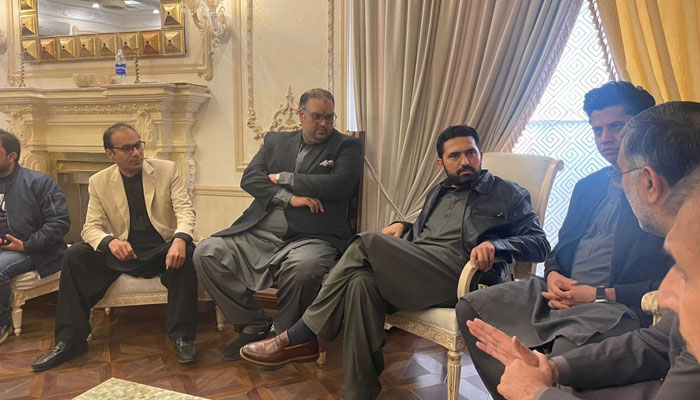

During the Chief Minister of Khyber Pakhtunkhwa’s recent three-day visit to Lahore, a meeting was arranged with bureau chiefs where several political and public-interest issues came under discussion. Although the interaction appeared informal on the surface, some of the statements made there carried serious implications and warrant deeper reflection.
I also had the opportunity to ask a question. Referring to an issue directly linked to the lives of ordinary citizens, I asked that Pakistan Tehreek-e-Insaf claims to be the country’s largest political party, yet what concrete and sustainable measures have been taken so far for the common man particularly for unemployed youth? Unemployment, especially among young people, is steadily turning into a national crisis.
In response, the Chief Minister of Khyber Pakhtunkhwa remarked: “Pakistan’s unemployed youth do not need jobs; they need Imran Khan.”
This statement did not come from an ordinary party worker, but from someone holding a high constitutional office. It raises several serious questions. Is today’s educated and unemployed youth really searching only for a personality instead of education, skills, employment, and a secure future? Or is this narrative an attempt to deflect attention from hard ground realities?
During the same interaction, while referring to Pak-India tensions, the Chief Minister stated that in the event of any external aggression, the entire nation would stand shoulder to shoulder with the Pakistan Army and give a befitting response. There can be no disagreement on this point national defence unites the entire country. However, the real question is whether governance has now been reduced merely to defensive rhetoric. Are internal challenges such as economic distress, unemployment, and social crises no longer part of the governing priorities?
On Khyber Pakhtunkhwa’s internal situation, the Chief Minister argued that the federal government is not treating the province fairly and is withholding its due share of resources, resulting in ongoing disputes between the centre and the province. He further remarked:
“Without resistance, reconciliation is not possible,” and stated that a street movement has already been launched under this philosophy
This again leads to a fundamental question: did the people elect the provincial government to take to the streets, or to ensure governance, job creation, and improved basic services?
Regarding past military operations in the province, the Chief Minister acknowledged that affected families were promised compensation of Rs400,000 per family, which has yet to be fully paid. This is not merely a political issue but a humanitarian and constitutional one, requiring practical action rather than statements.

On the issue of local government elections, the Chief Minister said that the government is working towards holding elections after making legal amendments. Yet the ground reality is that Khyber Pakhtunkhwa’s local government system has been effectively non-functional since 2021, with no clear or workable timeline in sight. Local governments are the backbone of any democracy; without devolving authority to the grassroots level, public problems cannot be resolved.
When we look at the province’s overall situation, available data contradicts the notion that people only seek leadership and not employment.
Khyber Pakhtunkhwa is currently facing severe socio-economic challenges, including high unemployment and a large number of out-of-school children. According to official and semi-official reports, the province’s unemployment rate is higher than that of other provinces. Educated youth wander with degrees in hand, while the lack of industrialisation and limited private investment further aggravate the crisis.
At the same time, nearly five million children in Khyber Pakhtunkhwa are reportedly out of school. Poverty, shortage of schools, lack of teachers, social barriers to girls’ education, and state neglect have made this crisis even more alarming.
These two problems are deeply interconnected. Children deprived of education grow up without skills or opportunities, feeding into unemployment and pushing the province into a vicious cycle of poverty, ignorance, and deprivation.
The most troubling aspect is that Khyber Pakhtunkhwa has been governed by the same political party for several years, yet neither sustainable employment opportunities have been created nor has any transformative progress been achieved in education. Political slogans and narratives may have their appeal, but ground realities tell a different story.
Today’s youth does not want slogans; it wants opportunities. It does not want perpetual agitation; it wants direction. It does not want just a leader; it wants leadership.
If those in power continue to treat the people’s fundamental issues as secondary, questions will multiply, trust will erode, and democracy will weaken further.
This is the moment of reflection especially for those who claim to represent the people.
Comments are closed, but trackbacks and pingbacks are open.