
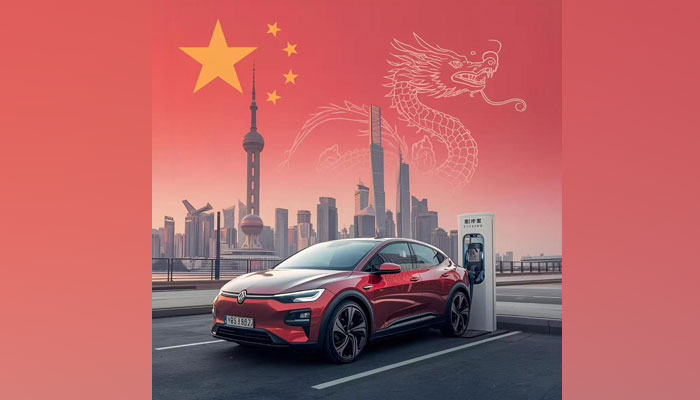
The Dragon’s Charge: Chinese EVs Reshaping the Global and Pakistani Automotive Landscape
By: Maher Ahsan

More strategically, establishing a manufacturing base in Pakistan allows Chinese companies to bypass potential trade barriers and tariffs in other regions, positioning the country as a potential regional manufacturing and export hub.The global automotive industry is undergoing its most profound transformation since the invention of the assembly line, and the driving force is no longer Detroit, Stuttgart, or Tokyo. It is Shenzhen, Shanghai, and Hefei. The rapid, technology-driven ascent of Chinese electric vehicle (EV) manufacturers has not merely introduced new competition, it has fundamentally redrawn the map of global automotive leadership. This seismic shift is now extending its reach into emerging markets, with Pakistan serving as a crucial new frontier, signaling a profound change in the nation’s automotive future.
China’s dominance in the EV sector is a story of strategic foresight, massive state support, and relentless vertical integration. The numbers speak for themselves: Chinese companies now account for an astonishing 58% to 62% of global EV production and sales. This is not just a matter of volume; it is a revolution in speed and efficiency. This efficiency is rooted in a comprehensive control over the supply chain, especially in battery technology. Companies like BYD (Build Your Dreams) and CATL (Contemporary Amperex Technology Co. Limited) are global leaders, with Chinese battery makers dominating approximately 60% of the world’s EV battery market. BYD, in particular, has leveraged its vertical integration producing everything from the battery cells to the final vehicle to become a global sales leader, even edging past established players in terms of battery electric vehicle (BEV) sales.

The expansion of Chinese EV manufacturers into Pakistan is a calculated move that serves both economic and geopolitical objectives. For Chinese firms, Pakistan represents a relatively untapped market with a growing middle class and a government increasingly keen on sustainable transport. The country’s 2025-2030 EV policy provides crucial incentives, making it an attractive destination for foreign direct investment. The entry of these players is marked by significant investment and commitment to localization. The most notable example is BYD, which has announced plans to roll out its first Pakistan-assembled car by mid-2026 from a new plant with a targeted capacity of 25,000 units per year.
Despite the promising outlook, the transition is not without hurdles. The primary challenge remains the charging infrastructure. While investments are being made, a robust, nationwide network is essential for mass adoption, especially for inter-city travel. Furthermore, the grid stability and the source of electricity generation must be addressed to ensure that the “green” transition is genuinely sustainable and does not merely shift the carbon footprint from the tailpipe to the power plant.
The expansion of Chinese EV manufacturers into Pakistan is more than a business transaction; it is a microcosm of a global paradigm shift. China’s dominance in the EV space is undeniable, built on a foundation of technological superiority and manufacturing scale. By leveraging Pakistan’s strategic location and supportive EV policy, these companies are not only securing a new market but are actively participating in the modernization of the country’s industrial base. The long-term impact will be a more competitive, technologically advanced, and environmentally conscious automotive sector in Pakistan, firmly integrated into the new global EV economy.
Comments are closed, but trackbacks and pingbacks are open.