

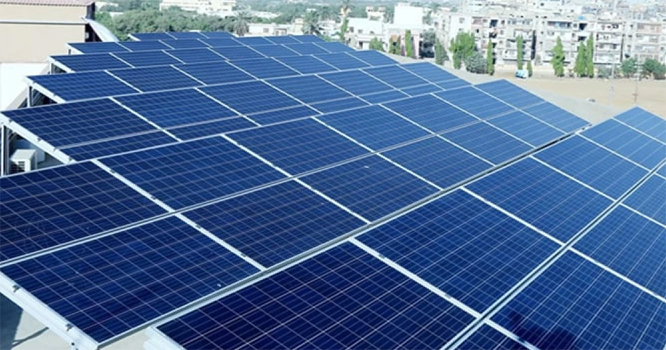
Pakistan Plans to Slash Solar Net-Metering Buyback Rate by Over 60% to Ease Fiscal Burden
Govt to Slash Solar Net-Metering Rates in Major Energy Policy Shift Backed by IMF

ISLAMABAD — The Government of Pakistan is preparing a major overhaul of its solar energy policy, with plans to cut the buyback rate for net-metered solar power from Rs27 per kilowatt hour (kWh) to just Rs10—more than a 60% reduction—in a bid to save Rs4.3 trillion ($15.1 billion) over the next decade, according to officials familiar with the development.
The Ministry of Energy is finalizing a revised solar policy that will align the net-metering buyback rate with what large-scale solar producers currently receive—between Rs9 and Rs11 per kWh. The move is part of Prime Minister Shehbaz Sharif’s broader energy reform agenda and has the backing of the International Monetary Fund (IMF), which approved a $7 billion loan for Pakistan in September 2024.
“The aim is to eliminate the pricing disparity and bring net-metering buyback rates in line with international practices,” said a senior official from the Ministry’s Power Division.
Standardized Buyback Rate for All Producers
Currently, domestic, agricultural, commercial, and industrial solar producers can sell their excess electricity to the national grid at high rates, encouraged by generous net-metering incentives. Under the new policy—expected to be submitted to the federal cabinet within a month—a uniform buyback rate tied to the national base tariff will be applied to all distributed solar producers.
“The key question is: at what rate should the government buy electricity from small-scale producers? That’s what we’re finalizing now,” the official added.
Solar Growth Outpaces Grid Integration
Pakistan has witnessed a dramatic rise in solar adoption in recent years. Imports of solar panels—mainly from China—have exceeded $2 billion annually, and installed solar capacity has grown more than fivefold since 2022. As of March 2025, Pakistan’s total installed electricity capacity stood at 46,605 MW, with net-metered solar systems contributing 2,813 MW.
Despite this rapid growth, actual generation from solar remains far below potential—only around 6,000 MW—due to panel efficiency limitations. The government is now looking to cap distributed solar generation at 8,500 MW to manage grid load and financial strain.
Energy Mix and Grid Challenges
While solar energy became Pakistan’s largest single electricity source in 2025, fossil fuels still dominate the national energy mix: 56% from thermal sources, 24.4% from hydropower, 8% from nuclear, and 12.2% from renewables.
The widespread use of rooftop solar has also led to reduced grid electricity consumption. From July 2024 to March 2025, total electricity usage dropped 4% to 80,111 GWh, partly due to increased off-grid solar reliance.
Financial Pressure and Policy Shift
Experts say the government’s generous buyback rates have become fiscally unsustainable. Shankar Talreja, head of research at Topline Securities, noted:
“The buyback rate—over Rs20 per kWh—made solar very appealing. People began installing rooftop systems and selling excess power to the grid.”
But now, the government wants solar users to remain connected to the grid and is pushing for buyback tariffs to be tied to the base rate, approximately Rs10 per kWh—or around 33% of the current rate.
Even K-Electric, Pakistan’s largest private utility, has agreed to supply solar power to the national grid at Rs10 per kWh. The company also signed an MoU with Huawei Digital Power Pakistan in June to develop battery energy storage and EV charging infrastructure.
Balancing Sustainability and Stability
While the shift aims to address fiscal imbalances, it also raises concerns about the pace of Pakistan’s energy transition. Managing the shift to renewables while ensuring grid stability and reducing dependence on imported fossil fuels remains a key challenge.
Read more: New solar buyback tariff set as net metering to be replaced
“The direction is right,” said Talreja, “but managing the transition while maintaining grid stability and financial sustainability is the real challenge.”

Comments are closed, but trackbacks and pingbacks are open.