
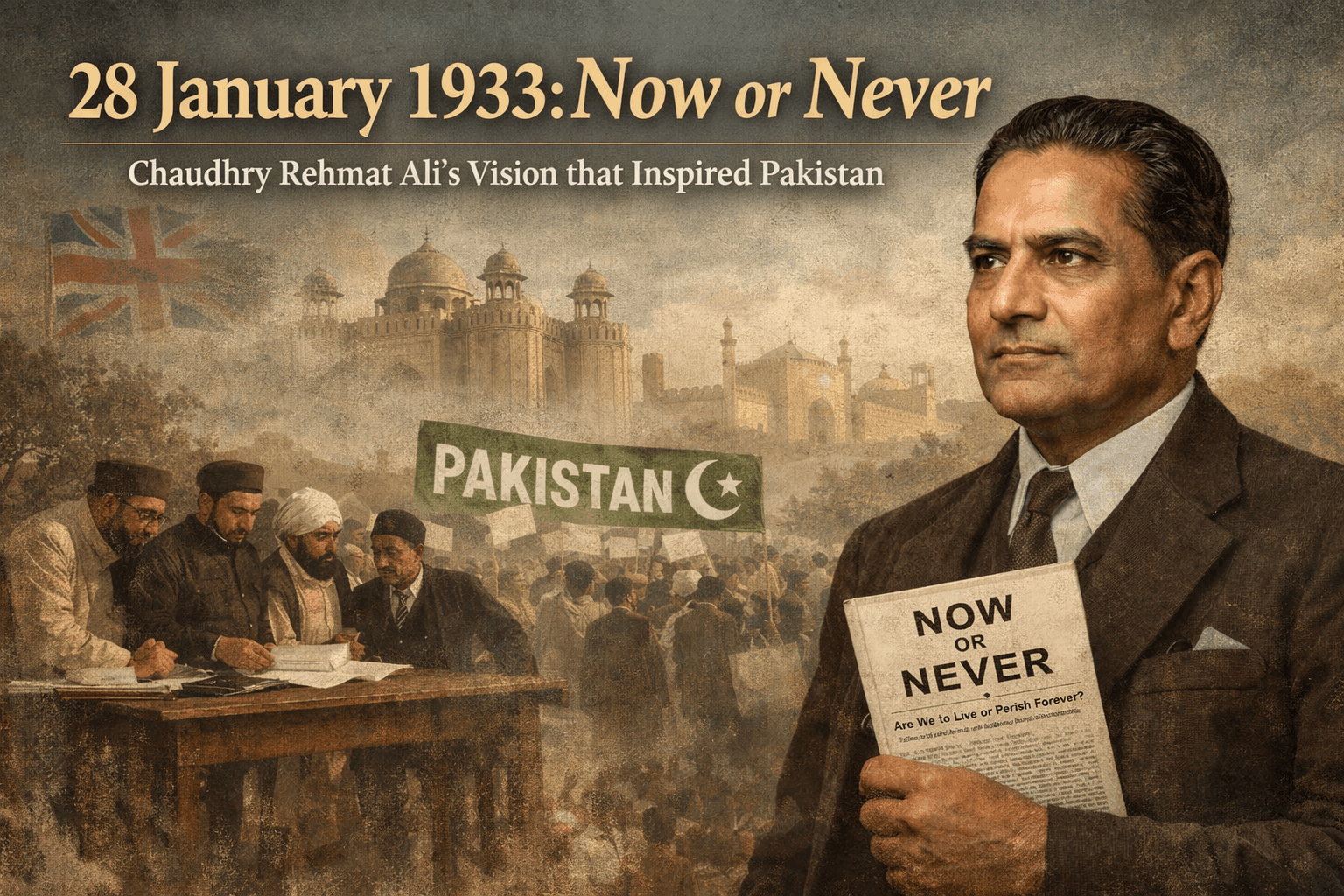
28 January: The Day That Could Not Be Ignored
28 January 1933: Chaudhry Rehmat Ali’s “Now or Never” inspired Pakistan’s creation, shaping Muslim identity, faith, and survival.

Professor Imran Ismail Chohan
History does not always announce itself with noise. Sometimes, the most decisive moments arrive quietly, almost unnoticed, yet they change the destiny of nations forever. Such days do not always find space in official calendars, but they remain engraved in the collective conscience of a people. 28 January is one such day—a day that, if ignored at the right moment, could have erased an entire future. A day that proved to be the thin line between survival and extinction for the Muslims of the subcontinent.
On 28 January 1933, a voice rose—not from the corridors of power, not from a throne or an army headquarters, but from the depth of conviction and foresight. That voice belonged to Chaudhry Rehmat Ali. With extraordinary clarity and courage, he presented before the Muslims of India a stark warning wrapped in a historic phrase:
“Now or Never.”
This was not a slogan born out of emotion or anger. It was a cold, rational, and deeply insightful reading of history in the making. Rehmat Ali understood what many refused to see: that Muslims, as a distinct religious, cultural, and political community, could not survive under a system dominated by a permanent majority. His message was blunt and unsettling—that accepting any constitutional arrangement within a united India would amount to signing the death warrant of Islam and Muslims in India.
At that time, the political environment of British India was filled with negotiations, round-table conferences, constitutional drafts, and assurances. Many Muslim leaders still believed that safeguards, quotas, and promises could protect Muslim interests in a united India. But Rehmat Ali saw beyond these temporary comforts. He knew that history does not preserve communities on promises; it preserves them through power, autonomy, and clear identity.
In Now or Never, Rehmat Ali did more than issue a warning—he offered a solution. For the first time, he clearly articulated the idea of Pakistan, not merely as a geographic entity, but as a homeland where Muslims could live according to their faith, culture, and political aspirations. Pakistan was not imagined as a luxury; it was conceived as a necessity for survival.
The tragedy of history is that those who see the future most clearly are often the most misunderstood in their own time. Rehmat Ali faced criticism, neglect, and isolation. Many dismissed his ideas as unrealistic or extreme. Yet, time proved that what was once called radical was in fact realistic—and what was called practical was dangerously naïve.
It is one of history’s great ironies that the man who first named Pakistan did not enjoy honor or comfort in the land his vision created. The architect of the idea remained on the margins, while the structure rose upon his blueprint. But history does not judge by rewards; it judges by impact. And the impact of 28 January 1933 is undeniable.
Today, we celebrate 14 August with national pride, but we rarely pause to reflect on 28 January. We commemorate resolutions, yet we forget the warning that made those resolutions inevitable. We teach outcomes, but neglect the intellectual struggle that preceded them. This selective memory weakens nations, because it disconnects them from the roots of their identity.

28 January reminds us that Pakistan was not born overnight, nor was it the result of a single political event. It was the culmination of a long ideological struggle, a struggle that began when someone dared to say “no” to comfortable illusions and “yes” to a difficult truth. Now or Never was not merely about territory—it was about dignity, faith, and the right to exist as a distinct civilization.
Even today, this message carries relevance. Nations continue to face moments when compromise seems easier than principle, when silence appears safer than resistance. 28 January questions us: Have we honored the clarity and courage that gave birth to Pakistan? Or have we once again trapped ourselves in hesitation, confusion, and short-term thinking?
This day also teaches us that history is often shaped by solitary voices. Voices that speak before the crowd is ready to listen. Voices that are mocked, ignored, or sidelined—until events force recognition. Rehmat Ali’s voice was one such voice. It echoed before others understood its meaning, and when they finally did, the course of history had already changed.
Remembering 28 January is not an act of nostalgia; it is an act of responsibility. It is a reminder that nations survive when they make timely decisions, when they recognize existential threats before they become irreversible realities. It teaches us that identity, once compromised, is almost impossible to reclaim.
If Now or Never had not been written, Pakistan might have remained a vague dream, or worse, an unrealized possibility buried under political convenience. That single declaration forced a community to confront its fate honestly. It demanded a choice—and history shows that survival belongs to those who choose decisively.
Therefore, 28 January must be remembered not just as a historical date, but as a moment of intellectual courage. A moment when fear was confronted with foresight, and uncertainty with resolve. It stands as a reminder that the existence of Pakistan is not accidental—it is the result of a timely, courageous, and uncompromising idea.
Because there are moments in the life of nations that truly are Now or Never.

Comments are closed, but trackbacks and pingbacks are open.